48° and Clear



Image
Abstract
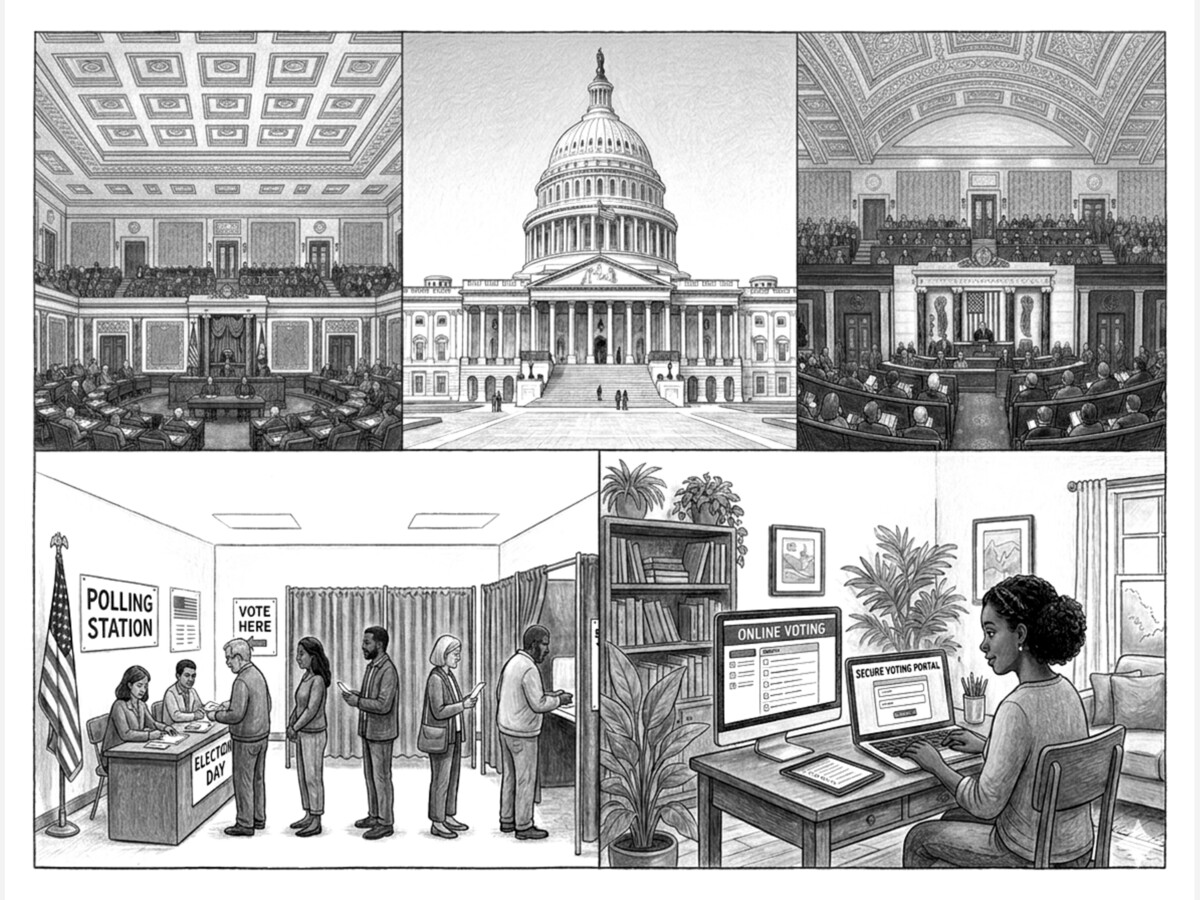
American democracy is undermined by structural and legal mechanisms that dilute the power of individual votes. The article highlights the outdated Electoral College, partisan gerrymandering, and restrictive voting laws as central problems that distort representation and suppress participation. The article also advocates reforms, including adopting the National Popular Vote Interstate Compact, expanding independent citizen redistricting commissions, and removing barriers to voting. Additional recommendations include implementing ranked choice voting to expand voter choice, establishing nationwide automatic voter registration, and modernizing election infrastructure with secure electronic voting. The article also proposes supplementing representative democracy with direct referendums, drawing inspiration from the Swiss model, and critiques the polarizing effects of the two-party system. The conclusion urges readers to support state-level reforms—such as independent redistricting, automatic voter registration, and ranked choice voting—as practical steps to strengthen democracy and ensure every vote counts.
Opinion - May 2026 - Iko Knyphausen
In 2016, 2.8 million more Americans voted for one presidential candidate. The other one became president. No law was broken. No ballots were altered. The system worked exactly as designed, and that is precisely the problem.
There is a particular kind of theft that never makes the headlines. No one is led away in handcuffs. The loss is not announced; it is engineered incrementally through laws, maps, and procedures so mundane that most people never notice until they wonder, sometime around midnight on election night, why the results feel so foreign to the country they actually live in.
American democracy is under sustained structural pressure. Not from foreign hackers or rogue officials, but from legal mechanisms: an antiquated Electoral College, congressional maps drawn to guarantee outcomes, voter registration hurdles designed to trip specific groups, and a ballot system that punishes voters for voting their conscience. Each, on its own, might be defended as a quirk of history or a technicality of governance. Together, they form something more deliberate: a system that increasingly reflects the will of parties, donors, and power brokers rather than the will of the people.
We have written before about the rise of oligarchical influence in American politics. Today, we turn to the machinery underneath, the nuts and bolts of how your vote is diluted, suppressed, or discarded before it ever has the chance to matter. And what a genuine democracy might look like instead.
When the founders gathered in Philadelphia in 1787, they faced a genuine practical problem: how to run a national election across a continent with no telegraph, no railroad, and no shared press? The Electoral College was their answer, a compromise that gave smaller states a structural cushion and entrusted educated “electors” with translating the popular will into an actual presidency. It made sense. Then.
In the centuries since, America built a national media, a universal public education system, and eventually the internet. We can count 150 million votes in a single evening. The rationale for an intermediary layer of electors has long since evaporated. What remains is the distortion.
The popular vote has diverged from the Electoral College outcome five times in American history, most recently in 2000 and 2016.1 In 2000, George W. Bush lost the popular vote to Al Gore by more than 500,000 votes, yet took the presidency after a Supreme Court decision ended a Florida recount with Bush ahead by 537 votes.2 In 2016, Trump won the Electoral College 304 to 227 but lost the popular count by 2.8 million votes.3
Stop and hold that number. 2.8 million more Americans wanted one outcome. They got the other.
The defense of the Electoral College rests on the idea that it protects smaller states from being steamrolled by populous urban centers. But a voter in Wyoming carries roughly three times the Electoral College weight of a voter in California. That is not protection; it is structural inequality, baked into the Constitution. Republicans won two presidential elections in 2000 and 2016 despite not winning the popular vote.4 Whether you lean left or right, a system that routinely delivers the presidency to the candidate fewer Americans chose deserves scrutiny.
A 2024 Pew Research Center poll found that 63 percent of Americans support replacing the Electoral College with a national popular vote.5 Abolishing it requires a constitutional amendment, a high bar. But the National Popular Vote Interstate Compact offers a path that does not. States agree to award their electoral votes to the winner of the national popular vote, and the compact takes effect once states representing 270 electoral votes have joined. As of April 2026, 19 jurisdictions possessing 222 electoral votes have enacted the compact into law, leaving just 48 electoral votes needed for it to take effect.6 It is a legal, incremental workaround that could restore the principle that every vote carries equal weight, without a single constitutional amendment.
Every ten years, following the national census, congressional districts are redrawn to reflect population shifts. In practice, the party in power in each state legislature draws those maps, and the temptation to draw them in self-serving ways has proved irresistible, across generations and across party lines.
The technique is simple and devastating. Pack as many opposition voters as possible into a small number of districts, letting them win those by landslides and waste their votes on margins they did not need. Then spread your own voters efficiently across many more districts, winning each by modest but reliable margins. The result is a congressional delegation that bears little resemblance to the state's actual voter distribution.
In North Carolina, the legislature drew a map that turned a 50-50 statewide vote into a 10-3 Republican congressional delegation.7 After the 2010 census, Wisconsin implemented a map that heavily favored Republicans, securing a disproportionate number of seats relative to their share of the vote through oddly shaped districts.8 Recent analyses by the Princeton Gerrymandering Project and the Brennan Center for Justice repeatedly flag Wisconsin, Texas, North Carolina, Maryland, and Pennsylvania among the states with the most extreme partisan maps.9
The Supreme Court largely withdrew from the problem in its 2019 Rucho v. Common Cause decision, holding that federal courts have no role in policing partisan gerrymandering. In North Carolina, the state supreme court ruled the maps were extreme partisan gerrymanders in 2022, but subsequent judicial elections changed the court’s composition, and in late 2023, the legislature enacted new gerrymandered maps anyway.10
Gerrymandering does not just steal representation. It kills competition, which kills accountability. When your seat is drawn to be safe, you answer to your base, not your constituents. The polarization we observe in Congress is not incidental to gerrymandering; it is a predictable consequence of it. As of 2025, seven states, including Arizona, California, Colorado, Idaho, Michigan, Montana, and Washington, have created independent citizen redistricting commissions responsible for drawing district boundaries without giving any one party an unfair advantage.11
The most effective form of disenfranchisement requires no conspiracy and leaves no fingerprints. You do not ban people from voting. You simply make voting difficult enough that certain people, predictably and specifically certain people, give up.
Over the last 20 years, states have erected barriers to the ballot box through strict voter ID laws, cuts to early voting, restrictions on registration, and aggressive purges of voter rolls. These efforts received a boost when the Supreme Court weakened the Voting Rights Act in 2013 in Shelby County v. Holder, and they have surged since the 2020 election.12
Consider the compounding effects. Eliminate mail-in voting and require in-person attendance. Reduce polling locations; in parts of Alabama and rural Georgia, some voters face drives exceeding 50 miles. Then layer on strict ID requirements: some proposals would demand that a voter’s driver’s license and birth certificate bear the same name. This sounds neutral until you consider that millions of American women have legally changed their surnames at marriage. Their birth certificates will never match their licenses. Obtaining a passport, a potential workaround, costs over $150 and requires weeks of processing. For many households, that is not a minor inconvenience. It is a prohibitive barrier.
According to the ACLU, 25 percent of voting-age Black Americans do not have a government-issued photo ID. Counties with larger minority populations have fewer polling sites and poll workers per voter. And in 2018, Black and Latino Americans were twice as likely as white Americans to be unable to get time off work while polls were open.13 By 2024, the Brennan Center reported that at least 30 states had enacted over 70 restrictive voting laws.14 Since the 2020 election, at least 29 states have enacted laws making voter ID rules stricter, reducing opportunities to vote by mail, and making ballot collection and voter assistance more difficult.15
Each restriction, in isolation, can be made to sound reasonable. In aggregate, they form a deliberate narrowing of the electorate, one that is not random in whom it affects.
Every election cycle, a familiar conversation plays out in living rooms across the country. Someone wants to vote third party. Their friends tell them not to, that a vote for a Libertarian or a Green is a wasted vote, or worse, a gift to the candidate they despise most. Reluctantly, the voter buries their convictions and selects the lesser of two evils.
This is not democracy. It is game theory masquerading as democracy.
The spoiler effect is the mechanism by which the two-party system perpetuates itself. As long as voting your conscience can harm your interests, rational voters are trapped. Third parties never gain traction. New ideas never break through. The Overton window stays narrow, and the two parties that control it stay in power.
Ranked choice voting (RCV) breaks this trap. Voters rank candidates in order of preference. If your first choice is eliminated, your vote transfers to your second. The winner earns genuine majority support rather than a plurality carved out of a split field. With RCV, there is no need to choose between the lesser of two evils; candidates compete for second-choice votes, which tends to produce more civil campaigns, and costly runoff elections are eliminated.16
In Alaska, RCV produced a result that traditional primaries rarely deliver: a moderate Democrat, Mary Peltola, won a House seat in a race that included several hardliners who would not be considered moderate by any definition.17 Maine has used RCV in federal races since 2018. Cities from Minneapolis to San Francisco have adopted it at the local level. Research compiled by the American Bar Association provides evidence that RCV improves representation, campaign quality, voter mobilization, and turnout compared to plurality voting.18
RCV is not without implementation challenges. Ballot design requires voter education, and counting is more complex than traditional first-past-the-post systems. Some jurisdictions have found that voters with lower civic familiarity need meaningful outreach to use ranked ballots effectively. These are real considerations, but they are solved problems in the dozen-plus democracies that use versions of ranked voting nationally. The resistance to RCV in the United States is not principled. It is institutional: the parties that benefit from the current duopoly control the legislatures that would need to adopt the change.
The United States asks its citizens to opt into democracy. Most other advanced democracies assume you are in. Automatic voter registration, tied to interactions with government agencies and anchored to the Social Security system every American enters at birth, should be the baseline, not an activist aspiration. As of November 2025, 24 states and the District of Columbia had enacted automatic voter registration policies, with California and Oregon becoming the first to do so back in 2015.19 That is progress, but it leaves more than half the country operating under an opt-in system that systematically undercounts the poor, the young, and the mobile.
Beyond that, we need a national voter registration database. Today, a person can register in two states simultaneously with no automated check. Maintaining 50 separate, incompatible state systems creates redundancy, enables error, and invites manipulation through roll purges, even as those same purges are used as a pretext to demand ever more burdensome identification from individual voters. The Brennan Center for Justice has shown through extensive research that voter fraud and illegal voting, often cited to justify regressive voting laws, are not widespread.20 A properly administered national register would eliminate duplicate registrations, reduce the pretexts for targeted purges, and lay the foundation for the reforms that follow.
Every day, Americans place profound financial trust online. We open bank accounts, file tax returns, purchase homes, and move retirement savings, billions of dollars secured by encryption, verified by credentials, and logged to permanent digital records. The notion that we cannot design an equally rigorous system for voting is not a technological argument. It is a political one.
To be precise about where we stand: secure, auditable online voting is an active area of serious academic and government research, not a fully solved problem. The analogy to financial transactions is imperfect; a fraudulent bank transfer can be reversed with relative ease, whereas correcting a compromised election is far more disruptive, typically requiring new elections. Proponents reasonably counter that a well-designed e-voting system with robust audit trails could actually make such verification faster and cheaper than under the traditional patchwork of paper and aging machines, but that infrastructure does not yet exist at scale. Any legitimate e-voting system would require verifiable audit trails, paper backup records, open-source code subject to independent review, and extensive piloting before broader deployment.21 Academic research published in peer-reviewed journals is actively advancing cryptographic architectures specifically designed to meet these requirements.22
What is clear is that the status quo, a patchwork of aging voting machines, paper poll books, and in-person requirements that functionally disenfranchise anyone who cannot take a day off work or drive 50 miles, is not defensible on security or democratic grounds. A phased approach makes sense: pilot online voting for overseas military and diplomatic personnel, then expand to specific accessible-voting populations, building the auditing infrastructure as we go. With a national voter registration system as its foundation, a secure online voting infrastructure would do something the current system structurally prevents: making participation easier than abstention.
Here is an uncomfortable question: when was the last time you agreed with every position of the party you voted for?
The American political binary demands that voters choose between two comprehensive platforms, two bundles of positions on dozens of unrelated issues, packaged together and sold as a take-it-or-leave-it proposition. You may be fiscally conservative and socially liberal. You may want strong environmental regulation and lower business taxes. You may support military readiness and universal healthcare. Neither party has a product for you. You pick the lesser evil and live with the rest.
Direct democracy, voting on specific questions rather than party representatives, is not a new idea, and it is not an untested one. No other country in the world holds as many referendums as Switzerland does. Citizens can influence laws and policies at the federal, cantonal, and local level through mandatory referendums, optional referendums, and popular initiatives.23 The Swiss electorate are called on approximately four times a year to vote on an average of fifteen issues.24 The result is not chaos. Switzerland consistently ranks among the world’s most stable, prosperous, and politically satisfied nations.
The objection worth taking seriously is the risk of populist capture: unconstrained direct democracy can produce majoritarian outcomes that harm minorities or that reflect panic rather than deliberation. The Swiss model addresses this with institutional safeguards. Constitutional amendments require a double majority: a majority of the national electorate and a majority of cantons, ensuring that no single population center can override the broader federation.25 A realistic American version need not be maximal: major fiscal legislation and constitutional amendments could be put to public ratification, with minimum turnout thresholds to prevent low-participation distortions. The goal is not to replace representative democracy but to give it a check it currently lacks.
The most modest version of this vision does not dismantle representative democracy. It augments it. Keep the Senate. Keep the House. Let legislators do what they do: draft complex legislation, negotiate in committee, navigate tradeoffs that require expertise and sustained attention. But before a bill becomes law, ask.
A national digital voting infrastructure does not need to cost what elections currently cost. According to OpenSecrets, the 2024 federal election cycle cost at least $15.9 billion in total spending, money spent almost entirely on persuading voters, not listening to them.26 A fraction of that, invested in civic infrastructure, could build a system that tells lawmakers in real time what their constituents actually want.
Lawmakers would then have to decide, on the record, whether to follow that signal or override it, and explain why. Right now, the explanation runs through K Street, not Main Street.
Here is something the Constitution never mentioned: political parties. Not once. And several of the men who wrote it were explicit about why. George Washington, in his farewell address, warned that the spirit of party was democracy’s “worst enemy,” a force that would allow “cunning, ambitious, and unprincipled men” to subvert the will of the people and seize power for themselves. James Madison worried in Federalist No. 10 about the violence of faction. They had seen what parties did to republics. They were right to worry.
What we have built instead is a binary machine. Two teams, two jerseys, two sets of approved opinions on dozens of unrelated issues bundled together and handed to voters as a package deal. You do not get to be for universal healthcare and a strong military, for environmental protection and lower business taxes, for criminal justice reform and secure borders, at least not without being accused of betraying one side or the other. The party platform flattens nuance into loyalty tests, and loyalty tests do not produce good governance. They produce tribalism.
The deeper damage is psychological. When politics becomes a team sport, the other side stops being fellow citizens with different views and becomes the enemy. We no longer debate; we perform. We no longer persuade; we signal. The language of political discourse has deteriorated from reasoned disagreement into ritualized contempt, and most people sense, correctly, that the contempt is at least partly manufactured. Rage is a product. It keeps people tuned in, donating, and showing up to vote against the villain rather than for anything in particular.
A cynic would call this by design. Divide et impera: keep the electorate busy fighting each other, and the people who are actually accumulating power, the donors, the lobbyists, the permanent influence class, can operate undisturbed. If working-class voters of different backgrounds are busy arguing about cultural grievances, they are not asking why their wages have stagnated while corporate profits hit record highs. If the professional class is consumed by partisan outrage, it is not examining which party’s donor base most benefits from the policies actually being enacted. The performance of division serves the interests of those who fund both teams.
None of this means the parties are identical, or that policy differences are fake. They are not. But the volume of tribal hatred is wildly disproportionate to the actual distance between most Americans on most issues. Poll after poll shows majorities across party lines agreeing on paid family leave, prescription drug prices, infrastructure investment, and basic anti-corruption measures. The disagreements are real but the blood-enemy framing is not. It is amplified, monetized, and deliberately sustained by those who benefit from a citizenry too busy fighting itself to look upward.
The structural reforms in this essay, independent redistricting, ranked choice voting, public financing, automatic registration, cannot alone fix a culture of performative polarization. But they would change the incentives. Candidates who must earn second-choice votes cannot afford to run purely on hatred of the other side. Representatives who do not owe their seats to extreme primary electorates can afford to work across the aisle. A legislature less dependent on large donors might occasionally represent the majorities that quietly agree, rather than the factions that loudly fight.
None of this is easy. Constitutional amendments are deliberately difficult. The parties that benefit from the current system control the legislatures that would reform it. And the machinery of suppression operates below the threshold of outrage, one precinct closure here, one ID requirement there, a district line nudged a few miles in a direction that happens to crack a competitive neighborhood in two.
But the arc of this story is not finished. Seven states have already established independent citizen redistricting commissions that bar politicians from drawing their own maps.27 Twenty-four states and the District of Columbia have enacted automatic voter registration.28 Ranked choice voting is expanding in cities and states. And public appetite for democratic reform, documented by RepresentUs, the ACLU, the Brennan Center for Justice, and nonpartisan polling across the ideological spectrum, is vast and underserved.
What can you do? Three things, right now. Support your state’s independent redistricting effort or ballot initiative. Contact your state legislators about automatic voter registration. And back local RCV pilots; cities are where electoral reform has always taken root before spreading upward.
Your vote is worth fighting for. But first, we have to make sure it counts.
The author writes on democracy, technology, and political accountability.
Notes & Sources
Opinion May 2026


This is really well done and should be read by everyone who will vote on the property tax levy lid increase in our upcoming election. I hope every LFP council member has already read it and understands it.
I'm impressed with the analysis but I didn't see any attribution so am curious to know whether this was written by a human or generated by AI.

Both.

Overcast, with a high of 60 and low of 45 degrees. Light drizzle for the morning, overcast in the afternoon, clear in the evening, overcast overnight.