

Image
Opinion | Iko Knyphausen | August 8th, 2026
The Senate Homeland Security Committee voted to hold Anthony Fauci in contempt this week, and Chairman Rand Paul says he’ll send the referral straight to the Justice Department, skipping the full Senate certification the underlying statute contemplates.[1] In the Senate, it wouldn't clear a 60-vote threshold. It will be up to the DOJ whether to seek a Grand Jury indictment based on the Committee referral alone. To understand how the man who ran the government’s infectious disease institute for 38 years ended up here, it helps to walk back through what’s actually undisputed first.
In December 2019, a pneumonia cluster appeared in Wuhan. By January 2020, scientists had sequenced the virus and mapped how it infects human cells. The US moved through the now-familiar sequence of school closures and remote learning, lockdowns and social distancing, mask mandates, and an accelerated vaccine effort that produced authorized shots by December 2020. Consequently, in early 2021, the government enacted vaccination requirements for federal workers, the military, and international travelers. A separate fight that gets tangled up with the origins question - lab leak or animal spillover - is still alive and kicking. None of this history is contested. What is contested is whether Fauci told the public and Congress the truth about what he knew and when.
A House subcommittee had overseen pandemic spending since 2020; when Republicans took the majority in January 2023, they repurposed it, renamed it the Select Subcommittee on the Coronavirus Pandemic, and pointed it at the origins question, gain-of-function research, and mandates instead. Over two years, reviewing more than a million pages of documents, it produced a 520-page final report in December 2024 concluding COVID-19 “most likely emerged from a laboratory in Wuhan, China.”[2] That conclusion deserves scrutiny in both directions. It’s built entirely from circumstantial evidence, and the committee never obtained the one thing that would actually settle it: WIV’s own lab records. The same report also relitigates mask & vaccine mandates and school closures in terms closer to grievance than finding, worth knowing since both conclusions came from the same process. It’s the grain of salt to consider when evaluating the findings.
Fauci first testified under this cloud in June 2024, telling the committee his longtime advisor David Morens “was not an advisor to me on Institute policy or other substantive issues.”[3] Morens’s own subpoenaed emails tell a different story: he tells EcoHealth Alliance’s Peter Daszak there’s “no worry about FOIAs” since material can reach “Tony” through private channels, boasts he learned from an NIH FOIA officer “how to make emails disappear,” and says he’d deleted “all of Peter’s emails and others relating to origin.”[4] That record is now the basis for the DOJ’s actual April 2026 indictment of Morens on conspiracy and records-destruction charges, and it’s what Fauci’s 2024 statement would have to survive in any contempt or perjury case.[5]
By July, three accusations against Fauci personally had crystallized, and Paul laid them out in the first half hour of a Senate hearing, in language closer to a prosecutor’s opening than a chairman’s.
The first was about private doubt. On a February 2020 call with a dozen leading virologists, Fauci’s own diary records “there was not total agreement about the likelihood of deliberate insertion,” and that most participants, except two, “felt deliberate insertion was possible.”[6] Days later, several of those same scientists authored “Proximal Origin,” the paper that became the scientific establishment’s main citation for natural origin, a paper Fauci had reviewed and edited before publication and later cited from the White House podium without disclosing that involvement.[7]
The second was about gain-of-function funding and testimony, and unlike much of what gets cited in this debate, this one is about something Fauci’s own agency actually funded and he personally denied under oath. That sounds like perjury on its face. It's more complicated than that. In May 2021, Fauci told the Senate flatly that “the NIH has never ever and does not now fund gain-of-function research in the Wuhan Institute of Virology.”[8] That statement rested on a narrow technical definition: under the federal oversight framework at the time, restrictions applied only to research enhancing an already-established human pathogen, and the bat coronaviruses NIH funded WIV to study had never been shown to infect humans, so nothing done to them counted as gain-of-function research going in. But the result, disclosed only when EcoHealth’s years-late grant report surfaced in 2021, was that a bat coronavirus engineered with a swapped-in spike protein made mice carrying the human ACE2 receptor sicker than expected, a demonstrated capability to infect through the same receptor human cells use.[9] Paul’s real point is that Fauci’s agency financed exactly that outcome and then, when the outcome arrived, argued it didn’t count: “you hid behind the narrowest possible definition. You can’t have it both ways.”[10]
The third was about record destruction. Paul’s committee had Morens’s emails describing deleted correspondence, and asked Fauci whether his 2024 sworn denial that he’d ever deleted federal records could be squared with them: “who’s telling the truth, you or your assistant?”[11] The question sharpens further given Fauci’s own subpoenaed email to then-NIH Director Francis Collins, sent February 2, 2020: “please delete this e-mail after you read it.”[12]
Paul closed his opening statement by comparing the lockdowns to a crime Fauci was “aiding and abetting.”[13]
What followed was silence. Fauci opened by saying Paul’s “obsession with calling for my prosecution” left him certain the hearing existed only to fulfill Paul’s public promise to see him “behind bars.”[14] He then invoked the Fifth to nearly every question, including some with no plausible incriminating content, whether there was a folder on the table, whether he kept a personal email account.[15] That breadth matters legally. The Fifth doesn’t require certainty of prosecution; under Hoffman v. United States, it requires only “reasonable cause to apprehend danger” from answering.[16] Questions about record destruction or the mouse experiment clear that bar easily. “Is there a folder in front of you?” or “What day of the week is it today?“ is a much harder case.
That breadth matters less than it looks like it should. Hoffman doesn't just protect answers that would directly incriminate; it protects any answer that could furnish 'a link in the chain of evidence' needed to prosecute, which is a considerably lower bar than it sounds. In a hearing where the chairman had already stated his desired outcome, even a factual answer about a folder or an email account can later become a building block, establishing access, timing, or a contradiction useful to a case assembled from many small pieces rather than one big one. There's also a narrower, more mechanical reason lawyers advise blanket invocation over selective answering: courts can treat partial answers on a topic as a waiver of the privilege for the rest of it, so a witness who answers the easy questions risks losing the shield for the hard ones. Judged against that standard, and in that setting, refusing to distinguish trivial questions from substantive ones looks less like obstruction and more like ordinary legal caution.
None of this settles where COVID came from. Fauci's private doubts and his testimony about funding definitions are questions about his honesty, not about the virus, and answering one doesn't answer the other. Record destruction sits differently: Morens's own account of deleting material 'relating to origin' means that accusation, if true, isn't just about candor; it may have actually narrowed what's left to investigate. Paul's suspicion that the dishonesty was meant to obstruct the origins inquiry is a fair inference from that specific evidence, even if it still doesn't tell us what the deleted material would have shown.
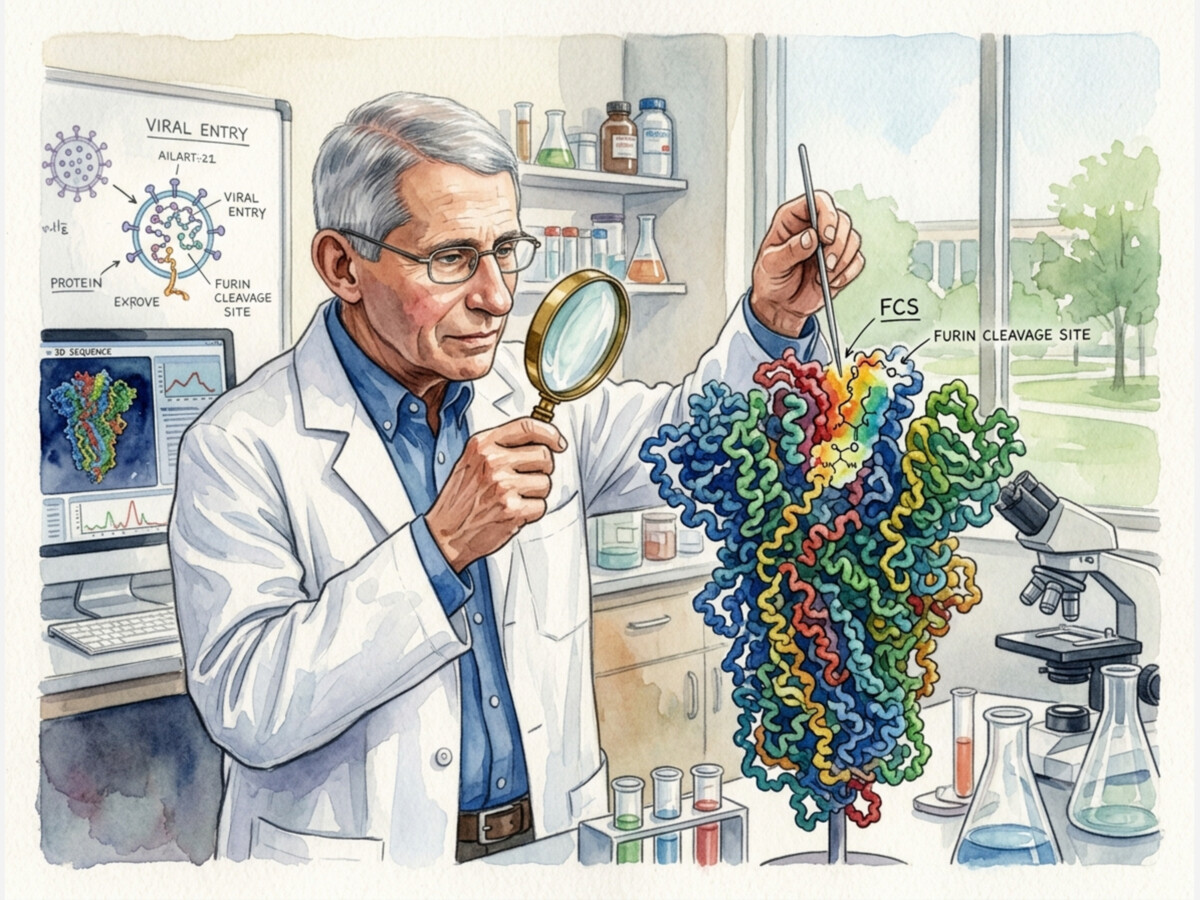
The strongest evidence for a lab origin is circumstantial and doesn't involve Fauci at all. In 2018, EcoHealth, a UNC lab, and WIV proposed DEFUSE, seeking DARPA funding to insert a furin cleavage site, the exact feature that makes SARS-CoV-2 unusually effective at entering human cells, into a bat coronavirus. DARPA rejected it, and by EcoHealth’s own account the specific work it described was never funded or carried out under any name.[17] Tulane virologist Robert Garry makes the point that actually matters here: no bat coronavirus close enough to SARS-CoV-2’s real lineage to serve as a plausible engineering backbone has ever surfaced publicly, from WIV or anywhere else, so there is “no actual evidence” tying DEFUSE, or the separate mouse experiment, to the pandemic strain itself.[18] WIV’s Shi Zhengli has said the lab held more than a hundred unpublished bat coronavirus sequences, any one of which could theoretically close that gap. Whether one does is the open question, and it’s one nobody outside WIV can currently answer.
The strongest evidence on the other side is less circumstantial than anything on the lab-leak side, though it isn't without its own critics. Two 2022 studies in Science mapped the earliest known COVID-19 cases and found them forming a geographic bull's-eye centered on Wuhan's Huanan market, not scattered evenly across the city the way you'd expect if the outbreak had started miles away at WIV.[19] Michael Worobey, the evolutionary biologist who led that analysis, put the odds of that pattern being coincidental at "1 in 10,000." A 2024 study in Cell went further, finding that coronavirus-susceptible wildlife, the virus itself, and infected people all overlapped in the same specific stalls of that market.[20] The Worobey paper has drawn a published statistical rebuttal arguing its methodology overstated how conclusively the data points to that one location, and it issued its own correction in 2024 after questions were raised about its distance calculations.[21] None of this proves a market origin beyond doubt; an intermediate host that would close the loop completely has still not been found. But even with those caveats, it remains more direct evidence than anything the lab-leak side has produced.
Which points to the real hinge of this fight: China still won't release WIV's lab records, its full virus sequence library, or its pre-outbreak safety logs, five years on. That refusal is the strongest evidence pointing toward a lab origin, not because refusing proves guilt, but because it's the one solid fact in this whole case that isn't circumstantial. If the lab were clean, China would have every reason to prove it, and it hasn't. That could mean it's hiding something. It could also just be a closed system defaulting to secrecy, the way authoritarian governments often do regardless of what they're protecting. Both are plausible. Only Beijing can settle which one is true.
So, did Dr. Fauci commit a crime?
Count 1: Being uncertain about whether COVID originated from a lab leak or a zoonotic spillover is not a crime. And although the majority of scientists in that infamous Feb 1st, 2020 phone call didn’t rule out engineering, it would be a far cry from asserting that it was. They jointly concluded, days later, that natural selection, not deliberate design, best explained the virus’s origin. The uncertainty was recorded in Fauci’s personal diary, not an official record. It’s like putting down initial ideas or concerns only to revisit and revise later. Hardly evidence of misleading Congress or the American people.
Count 2: Whether the engineered chimera referred to by NIH as SHC014-WIV1 (humanized mouse) qualifies as Gain of Function research depends on the definition. According to the narrow definition that includes only backbone viruses known to be human pathogens, Fauci was in the clear when he stated that NIH had never funded GOF research. Had he told Congress that this particular project was GOF in a broader sense, his statement might have fueled further speculation and conspiracies that would disregard the familiar distance to the actual SARS-CoV-2 virus. An unnecessary concern for public health.
Count 3: Fauci himself has not deleted any records. He may have asked a recipient to delete an email he sent as a personal opinion, but as we now know, that deletion hasn’t happened. The email is part of the record. No record was destroyed, neither by Fauci himself nor by the person he asked. One also has to weigh what information was potentially going to be destroyed. Was it benign or explosive? Would there be damage as a result?
This is roughly the movie some members of the committee seem to be writing in their heads: Fauci orders risky research to preempt a pandemic, the lab fails to contain it, a technician unknowingly carries it to the market, and Fauci spends the next five years covering his tracks. It has the shape of a great Oliver Stone movie script, tight causality, a guilty man managing the cover-up. It is also, on the actual evidence assembled here, mostly fiction, a story that requires WIV to have worked with a virus nobody has shown they had, evidence and inference must all click into place. Real events rarely have a script.
Fauci himself, in his diary, called a growing number of congressional letters - with conspiratorial seasonings - “an amazing and unbelievable waste of our time.”
None of this produces a crime. Uncertainty recorded in a private diary is not deception. A statement that tracked the regulatory definition then in force is not perjury. An email that asked someone else to delete a message, and that remains in the record, is not destruction of federal records. The contempt referral may still proceed on the breadth of the Fifth Amendment invocations; that is a narrower procedural question. What it will not do is convert political frustration over the pandemic response into evidence that Dr. Fauci committed an offense. The largest remaining gap in the entire story is still in Wuhan, not in Bethesda.
Iko can be reached at iko@uw.edu
Endnotes


Light rain shower, with a high of 56 and low of 46 degrees. Don't forget your umbrella! Light rain shower in the morning, light drizzle overnight.