Image
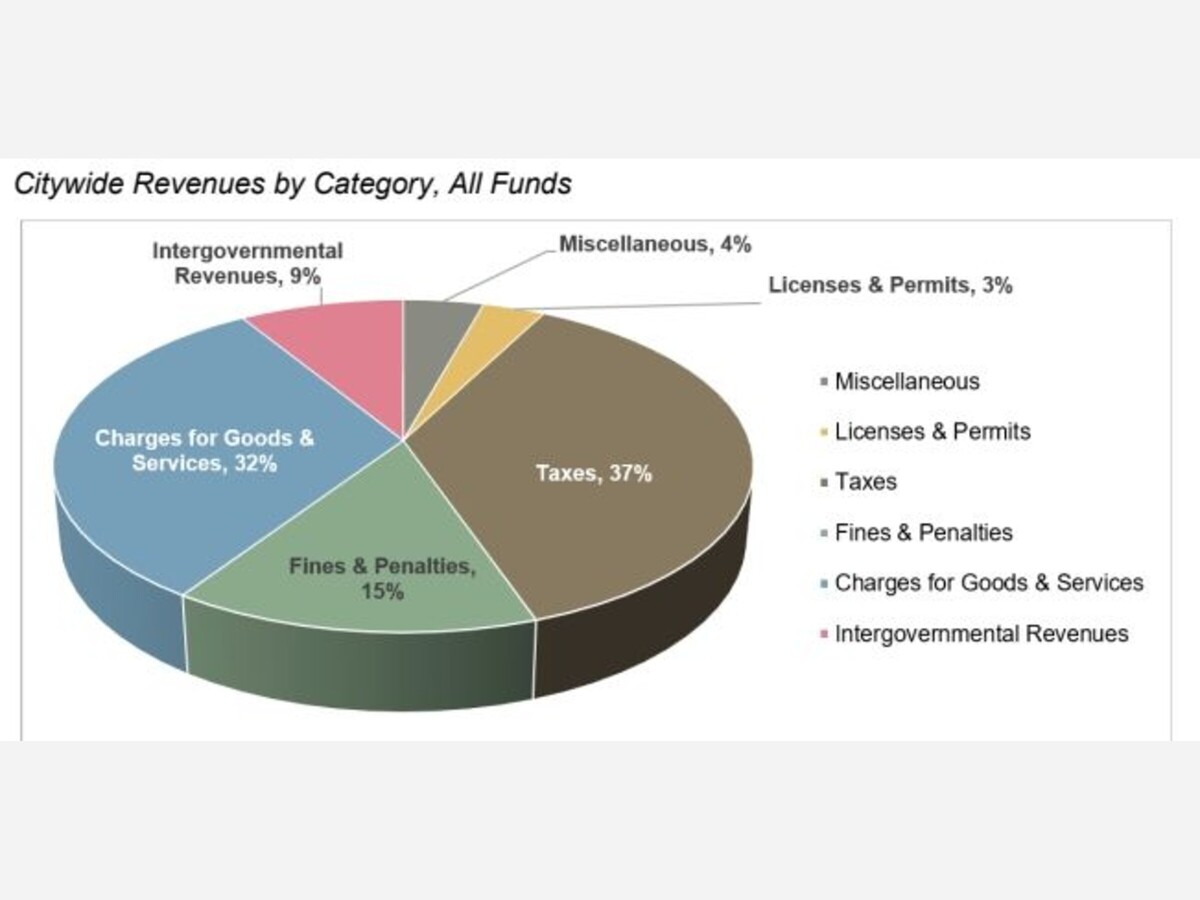
Source: LFP City 2027-2028 Biennial Budget



The City of LFP is having a public hearing regarding the upcoming budget and welcomes comments.
The author used ChatGPT to analyze the 244-page budget, which assisted in this analysis. Document reviewed: City of Lake Forest Park, Washington — Preliminary 2027–2028 Biennial Budget (attached below).
The central financial issue in this budget is the gap between the city's recurring revenues and its ongoing operating costs. The budget document acknowledges that the city continues to spend more on general operations than it receives from ongoing General Fund revenues, despite new revenue sources introduced in the previous biennium.
See Attachment-001-46ce9b6f296d41c5ab182a6cc8c94965.pdf
PROPOSED TWO-YEAR BUDGET AT A GLANCE
Total budgeted revenues
$63.55M
Total budgeted expenditures
$69.71M
Beginning fund balance
Projected ending fund balance
Projected reduction in fund balances
Source: Budget Overview, page 9 of the document (printed pagination). Figures cover all 18 budgeted funds combined.
These figures indicate that the city plans to use approximately $6.16 million more in resources than it receives in budgeted revenues over the biennium. That does not automatically mean every city fund is operating at a deficit: the city has multiple funds, some with dedicated revenue sources and restrictions. However, the document separately warns that the General Fund's projected ending balance will fall below the city's minimum fund-balance target in 2028.
See Attachment-001-46ce9b6f296d41c5ab182a6cc8c94965.pdf
The key questions are therefore:
The General Fund supports much of the city's day-to-day government, including police, administration, municipal court, planning, and other core services.
GENERAL FUND — 2027–2028
Projected revenue
$28.12M
Projected expenditures
$32.61M
Two-year operating gap
$4.49 million
Projected General Fund ending balance: $1.51 million, compared with the required reserve target.
Source: Schedule of Fund Balances, printed pages 48–50.
See Attachment-001-46ce9b6f296d41c5ab182a6cc8c94965.pdf
The city's financial policies require the General Fund to maintain a minimum reserve equal to 60 days of operating expenses or 16% of estimated current-year revenues or expenditures, whichever is greater. The budget identifies the General Fund as falling below its required target by the end of 2028.
See Attachment-001-46ce9b6f296d41c5ab182a6cc8c94965.pdf
The budget can be legally balanced using available savings while still having a structural operating deficit. Those are two different concepts.
The proposed budget addresses the first condition, but the city's projections show problems with the second and third.
The budget includes a forecast of General Fund balances extending through 2032.
General Fund ending balance forecast
Projected General Fund Ending Balance
Forecast balances for each biennium. Negative values indicate a projected shortfall in the General Fund balance.
Source: Six-Year Financial Forecast, printed page 170. The 2027–2028 figure here is $1.44 million; the separate fund-balance schedule reports $1.51 million.
See Attachment-001-46ce9b6f296d41c5ab182a6cc8c94965.pdf
The forecast shows a progression from a General Fund balance of approximately $10.32 million at the end of 2023–2024 to a projected negative $8.34 million by the end of 2031–2032 if the modeled conditions continue.
The projections are not guaranteed outcomes. They depend on the city's revenue and expenditure assumptions, including inflation, healthcare costs, and anticipated sales-tax growth. Nevertheless, the forecast indicates that the issue is not limited to a single two-year budget cycle.
See Attachment-001-46ce9b6f296d41c5ab182a6cc8c94965.pdf
The forecast should be updated as actual 2025–2026 results become available and the 2027–2028 budget is revised or adopted.
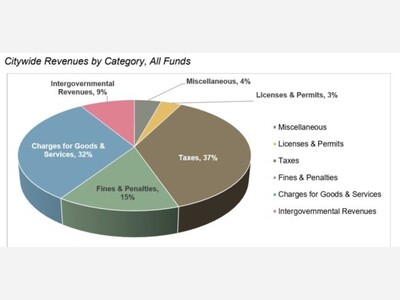
The budget identifies the following major citywide revenue categories for 2027–2028.
See Attachment-001-46ce9b6f296d41c5ab182a6cc8c94965.pdf
| Revenue category | Budgeted amount |
|---|---|
| Taxes | More than $21.6 million |
| Charges for goods and services | Nearly $18.3 million |
| Fines and penalties | More than $8.5 million |
| Intergovernmental revenue | More than $5.4 million |
| Licenses and permits | Approximately $1.9 million |
| Miscellaneous revenue | Approximately $2.5 million |
These figures are rounded descriptions from the budget overview.
A critical distinction is that citywide revenue is not the same as money available to the General Fund. Sewer and surface-water fees support their respective utilities; real estate excise taxes are restricted to authorized purposes; and certain traffic-camera proceeds are restricted to traffic-safety uses. The city cannot simply redirect all these revenues to pay for police, administration, or other general operations.
See Attachment-001-46ce9b6f296d41c5ab182a6cc8c94965.pdf
The mayor's budget letter attributes the recurring revenue gap partly to Washington's 1% limit on annual growth in regular property-tax revenue, alongside unfunded state mandates and rising service costs. The administration supports a voter-approved property-tax increase for existing city operations.
See Attachment-001-46ce9b6f296d41c5ab182a6cc8c94965.pdf
The financial question for council and residents is how the city's ongoing costs compare with the recurring revenues legally available to pay them. That question should be examined separately from the merits of any particular revenue proposal.
See Attachment-001-46ce9b6f296d41c5ab182a6cc8c94965.pdf
A useful next step would be to compare actual revenue collections for 2024–2026 with the proposed 2027–2028 assumptions, especially for traffic-camera fines, sales tax, business tax, and investment income.
The city identifies several cost drivers in its budget documents:
ITEM-Attachment-001-46ce9b6f296d41c5ab182a6cc8c94965.pdf
The largest citywide expenditure categories are public safety, at more than $16.3 million, and general government, at nearly $14.8 million, followed by utilities at more than $10.5 million. These figures cover the entire city budget, not just the General Fund.
See Attachment-001-46ce9b6f296d41c5ab182a6cc8c94965.pdf
The proposed budget authorizes 70.30 full-time-equivalent positions, compared with 66.15 at adoption of the 2025–2026 budget — an increase of 4.15 FTEs, or approximately 6.3%. The budget identifies four FTEs as fully funded through the Traffic Safety Fund.
See Attachment-001-46ce9b6f296d41c5ab182a6cc8c94965.pdf
That distinction matters: a higher total staffing count does not necessarily translate into the same increase in General Fund costs. The relevant analysis is the net cost to each fund, including salary, benefits, overtime, and interfund charges.
These questions help distinguish unavoidable cost pressures from areas where the city has discretion.
The preliminary budget includes approximately $17.55 million in capital improvement projects for 2027–2028, with approximately $9.32 million in projected 2027 costs and $8.23 million in 2028 costs. Major projects include the SR 104 and 40th Place NE roundabout, lakefront park development, sewer lift-station work, culvert replacement, and street and pedestrian improvements.
See Attachment-001-46ce9b6f296d41c5ab182a6cc8c94965.pdf
Many of these projects use dedicated utility revenues, grants, transportation funds, or other restricted resources. Their total cost should therefore not be treated as if it were all competing directly with General Fund operating expenses.
The budget also recognizes a $2.5 million loan from the Transportation Improvement Board to help fund the roundabout project. The debt section reports that the city's existing outstanding debt was below 1% of its stated debt capacity, while noting that the additional loan supports this capital project.
See Attachment-001-46ce9b6f296d41c5ab182a6cc8c94965.pdf
The financial review should consider both project funding and the future cost of maintaining completed infrastructure. The city's financial policies require incorporating maintenance and operating costs for new capital projects into operating budgets once those projects are completed.
ITEM-Attachment-001-46ce9b6f296d41c5ab182a6cc8c94965.pdf
The General Fund is not the only area to watch.
| Fund | Budget issue |
|---|---|
| Sewer Utility | King County wastewater treatment costs are projected to rise 12.75% in 2027, with another 10% proposed for 2028. The city proposes 5% annual sewer-rate increases. |
| Surface Water Utility | The budget includes a 10% rate increase for each year to support ongoing operations, permitting compliance, and future capital work. |
| Street Fund | Declining right-of-way permit revenues and inflation are creating operating pressure; General Fund transfers help support street maintenance. |
See Attachment-001-46ce9b6f296d41c5ab182a6cc8c94965.pdf
Utility rates need to be assessed against the full cost of service, including treatment charges, operations, capital projects, and reserve requirements. A rate increase may improve a utility's finances, but its adequacy depends on the actual cost trajectory and customer revenue.
The mayor's letter states that several potential expenditures were excluded from the preliminary budget to limit the General Fund deficit:
The letter says the administration would work with the council to identify service-level reductions if the November 2026 ballot measure is unsuccessful.
See Attachment-001-46ce9b6f296d41c5ab182a6cc8c94965.pdf
This makes the trade-off explicit: the city is attempting to maintain current services while relying on savings, and the preliminary budget does not include all identified staffing and planning needs.
For evaluating possible changes, council could request a side-by-side analysis of three scenarios:
Each scenario should use the same economic assumptions and distinguish recurring changes from one-time funding.
These questions are directly tied to the risks identified in the document.
What is the exact General Fund reserve shortfall at the end of 2028, and how is it calculated under the city's 16% policy?
Can staff provide a year-by-year General Fund forecast through 2034, with and without proposed new recurring revenue?
Which expenditure categories account for the largest increases compared with actual 2025–2026 spending?
What assumptions support the projected growth in traffic-camera fines, sales tax, and business tax?
Which revenues and fund balances are legally restricted, and which are available for general operations?
What service reductions would be required if additional recurring revenue is not approved?
How sensitive is the forecast to healthcare costs, labor agreements, inflation, and slower-than-expected revenue growth?
What are the projected operating and maintenance costs of capital projects once construction is complete?
The preliminary budget clearly distinguishes between short-term budget balance and long-term financial sustainability. The city projects a $4.49 million General Fund revenue-expenditure gap for 2027–2028, an ending balance below its reserve target, and negative General Fund balances in its out-year forecast if the modeled conditions persist.
See Attachment-001-46ce9b6f296d41c5ab182a6cc8c94965.pdf
The most consequential part of the review is not simply the size of the total city budget. It is whether recurring General Fund revenues can support recurring services while preserving the city's required reserves.
Before final adoption, the most useful additional information would be a detailed, year-by-year General Fund forecast that reconciles the different ending-balance figures in the budget, identifies the assumptions driving the projected deficit, and quantifies the effects of alternative revenue and expenditure scenarios.
Projected General Fund Ending Balance
Forecast balances for each biennium. Negative values indicate a projected shortfall in the General Fund balance.
| period | balance |
|---|---|
| 2017–18 | 4,078,519 |
| 2019–20 | 4,812,962 |
| 2021–22 | 7,879,903 |
| 2023–24 | 10,316,028 |
| 2025–26 | 5,998,911 |
| 2027–28 | 1,437,948 |
| 2029–30 | -3,311,023 |
| 2031–32 | -8,341,824 |

This is really well done and should be read by everyone who will vote on the property tax levy lid increase in our upcoming election. I hope every LFP council member has already read it and understands it.
I'm impressed with the analysis but I didn't see any attribution so am curious to know whether this was written by a human or generated by AI.
Both.
For the sake of credibility, I think it's super important to proactively label AI generated text. For something like this, I'd want to see some info about what AI model you used and what you asked it to do. For something like this, where the choice might be between using AI and not providing the budget analysis at all, it's not unreasonable to use AI... but if you're not telling the reader up front, it really undermines trust in the whole site.

Overcast, with a high of 59 and low of 44 degrees. Overcast during the morning,


This is really well done and should be read by everyone who will vote on the property tax levy lid increase in our upcoming election. I hope every LFP council member has already read it and understands it.
I'm impressed with the analysis but I didn't see any attribution so am curious to know whether this was written by a human or generated by AI.
Both.