68° and Overcast
Lake Forest Park
Tue. Oct 20 2026
Notice of Public Hearing- 2027 General and Property Taxes
Chris Clasen
Editor



An opinion response regarding this post.
I became involved with the Foundation for the Study of Cycles in 1983. About a decade later I met William Strauss and Neil Howe (Strauss passed away in 2007), and I remain friends with Neil today. While that doesn't make my interpretation definitive, it has given me a long familiarity with Fourth Turning theory, generational dynamics, and the study of long-term historical cycles.
I don't dispute much of the historical material you've presented. My concern is that you've taken a broad cyclical framework and narrowed it into a primarily partisan narrative centered on Steve Bannon and Donald Trump.
If the Fourth Turning framework teaches us anything, it is that systemic crises emerge from the accumulated failures of institutions over many decades—not from one individual or one political movement. Focusing primarily on Bannon and Trump risks overlooking the bipartisan nature of those institutional failures.
I agree that powerful political, financial, and institutional elites exert enormous influence over public policy. However, those networks are not confined to one political party. They exist across Republican and Democratic administrations alike. Bannon, whether one agrees with him or not, is only one participant within a much larger political ecosystem.
There is an extensive body of literature examining elite power structures, their institutions, and their influence on public policy. Whether one agrees with every conclusion drawn in that literature or not, it is difficult to argue that influence is limited to one side of the political spectrum. The same observation applies to organizations and donors often associated with the political left, such as George Soros' Open Society Foundations, just as it applies to influential organizations and donors associated with the political right. Concentrating on only one side presents an incomplete picture.
From my perspective, the populist movements emerging on both the right and the left often reflect different expressions of the same underlying public frustration with entrenched institutions. They differ ideologically, but both arise from a growing loss of trust in political, economic, and cultural leadership.
Many influential institutions have long recruited exceptionally talented academics, business leaders, and policymakers who sincerely believe they are working toward "the greater good." The critical question has always been: who defines that greater good, and who benefits from it? Authors such as H.G. Wells, Aldous Huxley, and C.S. Lewis each explored, in very different ways, the tension between centralized power, ideology, and individual liberty.
Whether or not Bannon's interpretation of the Fourth Turning is correct is ultimately beside the point. If Howe and Strauss are right, the crisis is the product of decades of institutional drift, fiscal excess, declining civic trust, and cultural polarization. Those forces were developing long before Donald Trump entered politics and will continue regardless of any single political figure.
For readers interested in the moral foundations behind today's political divisions, I would strongly recommend the work of Jonathan Haidt, particularly The Righteous Mind and The Coddling of the American Mind. His research helps explain why intelligent, well-intentioned people can reach dramatically different political conclusions while believing they are acting ethically.
Ultimately, I believe this is less a Democrat-versus-Republican struggle than an "us versus them" problem. Ideologies become tools that divide citizens into competing camps while attention is diverted from deeper structural issues. Political identity, class conflict, race, and countless other divisions can become mechanisms that keep citizens fighting one another rather than examining the institutions and incentives that shape public policy.
In my view, meaningful reform will require more than replacing one party with another. It will require restoring transparency, accountability, and genuine oversight across our institutions—Congress, the executive agencies, the Federal Reserve, and the industries whose interests have become deeply intertwined with government. A period of disruption may well be necessary to unwind crony capitalism, reduce regulatory capture, and restore public confidence.
If the Fourth Turning thesis is correct, the challenge before us is not choosing between left and right. It is determining whether our institutions can be reformed in ways that preserve constitutional government, individual liberty, and public trust before the crisis reaches its inevitable climax.
We are clearly at a turning point. The warning signs are difficult to ignore: declining trust in institutions, rising public debt, increasing political polarization, expanding surveillance and technology, growing concentration of economic power, and a loss of local decision-making. These trends deserve serious discussion regardless of one's political affiliation.
When influential organizations speak of reshaping global governance, economies, or public policy, citizens should ask thoughtful questions about accountability, transparency, and individual liberty. Every proposal—whether it comes from governments, multinational corporations, international organizations, or political movements—should be evaluated on how it affects constitutional rights, local self-government, free expression, and personal freedom.
The real question is not whether change is coming—it is. The question is who will shape that change, under what principles, and with what safeguards. Rather than allowing ourselves to be divided into competing political tribes, this is the moment to step back, think critically, and focus on preserving the institutions and freedoms that allow free societies to flourish.
Bryce James

Sunny, with a high of 68 and low of 43 degrees. Sunny in the morning, overcast in the afternoon, clear overnight.



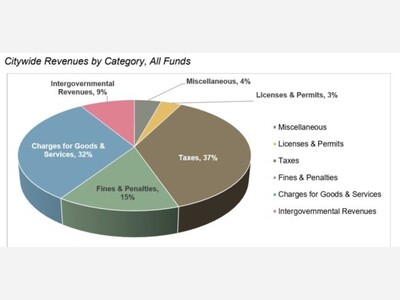

This is really well done and should be read by everyone who will vote on the property tax levy lid increase in our upcoming election. I hope every LFP council member has already read it and understands it.
I'm impressed with the analysis but I didn't see any attribution so am curious to know whether this was written by a human or generated by AI.
Both.