

Image
Opinion - Iko Knyphausen - October 25th, 2026
In July 2007, Citigroup's chief executive Chuck Prince told the Financial Times that the cheap-credit boom in leveraged buyouts would end eventually, but that he saw no reason to step off the floor yet. "As long as the music is playing, you've got to get up and dance."1 Four months later he resigned, and the line became the epitaph of the financial crisis. It is usually quoted as proof of hubris. Read again, it sounds more like a confession. Prince knew the music would stop. He simply understood that the man who sits down early gets fired long before the man who dances until the end.
That is the quiet engine of every bubble, and it is running at full speed in artificial intelligence. We call it FOMO, the fear of missing out, an acronym that makes it sound more adolescent than it is. Picture a chief executive weighing two possible mistakes. If AI proves transformative and she held back, her company becomes a footnote and she becomes the executive who missed it. If AI proves overhyped and she spent heavily, she is in the same boat as every competitor, and boards forgive errors that everyone made together. Those of us who worked at IBM in the 1980s knew the corporate version by heart: nobody ever got fired for buying IBM. John Maynard Keynes said it more elegantly in 1936, observing that worldly wisdom finds it "better for reputation to fail conventionally than to succeed unconventionally."2
What makes this moment unusual is how openly the dancers discuss the music. Earlier this month Ray Dalio called AI a classic bubble approaching its bursting point.3 On October 20, Ken Griffin of Citadel said investors are "almost certainly" in one.4 The next day, BlackRock's Larry Fink argued for pressing ahead with the data center build-out, warning that delays could slow growth and drive up computing costs.5 Nobody at the party believes the punch bowl is bottomless. They simply see no rational way to be the first to leave.
So the question of whether AI is in a bubble has become less interesting than it sounds. Most bubbles are recognized while they are still inflating. The more useful question is what this one is made of, because that decides who gets hurt when it goes.
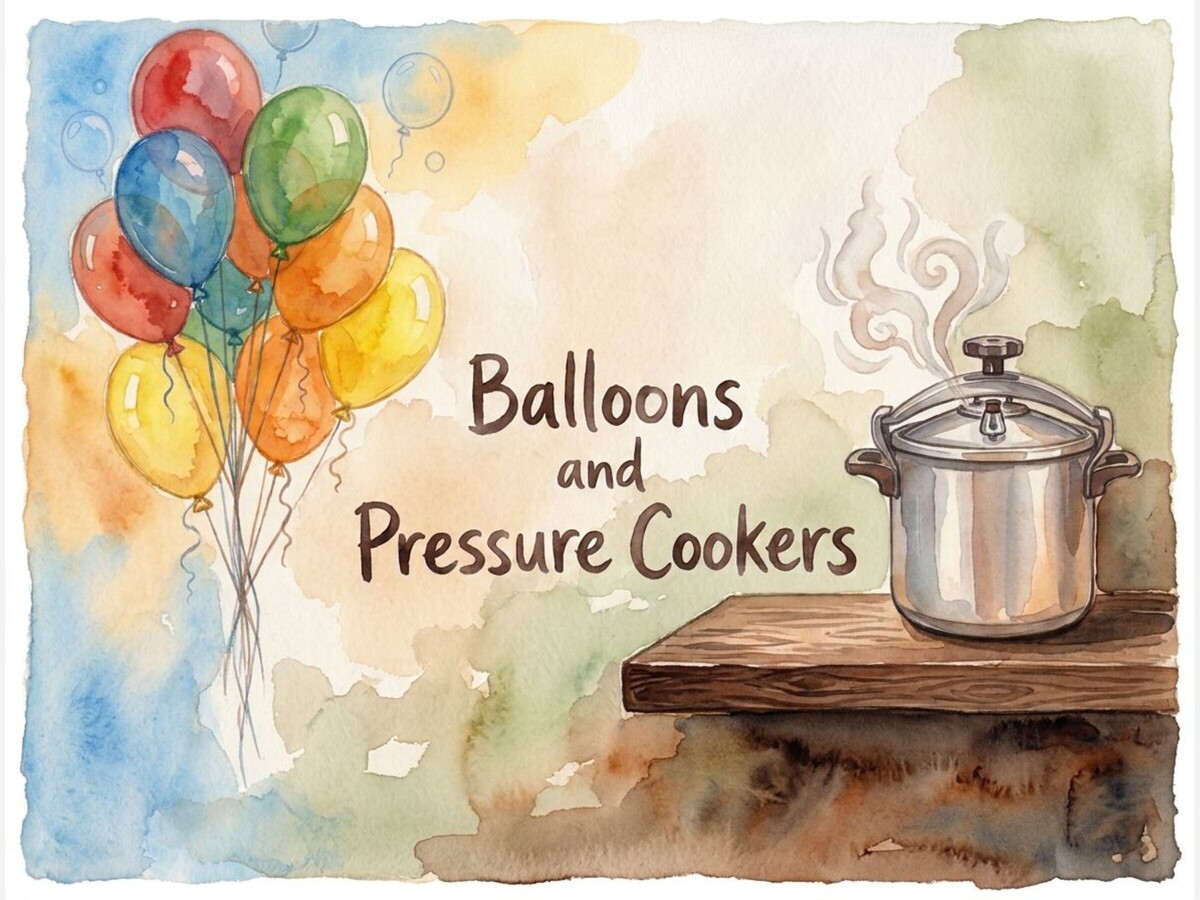
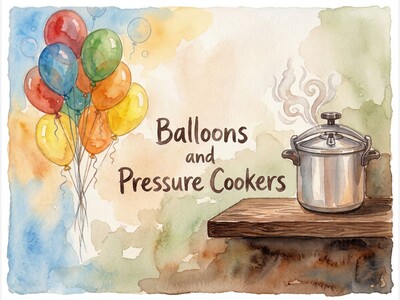
Consider two containers of air. A party balloon is filled by the breath of the people holding it. When it pops there is a bang, some disappointed faces, and a scrap of rubber on the floor. The dot-com bust was a balloon. Investors bought shares with their own money, lost a great deal of it, and the banking system carried on. Economic history largely confirms the pattern: research on the postwar era finds that equity bubbles have rarely turned into financial crises, with the important exception of bubbles fueled by borrowed money.6
A pressure cooker is a different device. It holds far more energy than a balloon and is built to do so safely, provided the valve works. When the valve fails, the lid leaves the stove. Debt is what turns a balloon into a pressure cooker, and the AI build-out increasingly runs on it. The economist Barry Eichengreen notes that data center construction now costs more than the sponsoring companies generate in free cash flow, with tenant revenue still a distant prospect, so much of the gap is borrowed from private credit funds.7 Some of that borrowing sits at arm's length from the companies that benefit. Meta's Hyperion data center is reportedly 80 percent owned by the investment firm Blue Owl and 20 percent by Meta, which leaves most of the debt on Blue Owl's books while Meta occupies the building.8 The International Monetary Fund has flagged a further hazard: circular deals in which AI firms serve as one another's investors, financiers and customers, so that trouble at one company quickly becomes trouble at the next.9
In a healthy credit system the lender is the safety valve. Lenders are supposed to be the sober guests, the ones who look at the numbers and decline to pour another round. Here the FOMO argument circles back, because the people who should be saying no are increasingly paid to say yes. Private credit managers earn fees by putting money to work, and Eichengreen observes that they have been acquiring insurance companies whose large portfolios they can then fill with their own loans.7 Writing in the New York Times on October 25, Jen Harris, a former economic official in the Biden White House, points out that Apollo funds part of its lending through Athene, a $470 billion insurer it controls, and that annuity policies are generally backed by the state if an insurer fails. By her count, firms backed by private capital now own nearly a fifth of the American life insurance industry.10
That detail should keep regulators awake. The retiree who bought an annuity a few years ago never chose to bet on data centers. She is simply standing in the kitchen near the stove. If the valve fails, the people closest to the blast are those who never touched the dial, and the guarantee behind them is, in the end, the taxpayer.
Markets have noticed. In a Bank of America survey this summer, 48 percent of global fund managers named AI hyperscaler spending as the most likely source of a systemic credit event.11 Fairness requires the strongest counterargument as well. Steve Chiavarone of Federated Hermes contends that lenders are still distinguishing between borrowers and charging the weaker ones more, the opposite of the indiscriminate cheap money that marks a true bubble.12 If he is right, the valve still works.
That gives the rest of us something more useful than a prediction: a gauge to watch. When the extra interest charged to risky AI borrowers shrinks toward what safe ones pay, the lenders have caught the fever too, and the valve has been quietly welded shut. Chuck Prince, to his credit, also warned in that 2007 interview that things would get complicated once the music stopped. Nineteen years later the music is different and the dance floor far larger. How complicated it gets will depend on whether we are holding balloons or standing by the stove.


Overcast, with a high of 55 and low of 44 degrees. Light drizzle during the morning, patchy rain nearby in the afternoon, overcast during the evening,