48° and Mist


Image
Banned Books Week, observed this year from Oct. 4 through Oct. 10, is bringing renewed attention to a national debate over which books should be available to students and library patrons—and who should decide.
The American Library Association (ALA) reports that 4,235 unique book titles were challenged in U.S. libraries during 2025, the second-highest number recorded since the organization began tracking challenges. The record was 4,240 titles in 2023.
The ALA also documented 5,668 books that were ultimately removed from libraries in 2025, along with another 920 titles whose access was restricted, such as by relocating them or requiring parental permission. The organization cautions that its figures reflect only reported challenges and therefore do not capture every challenge or removal.
This year's Banned Books Week theme is “Let Books Be. Protect the Freedom to Read.” The ALA organizes the observance nationally, and libraries, bookstores, schools, authors, and other organizations support it.
The terms challenge and ban are sometimes used interchangeably, but they describe different things.
The ALA defines a book challenge as an attempt to have library material removed or have access to it restricted because of objections to its content. A challenge may result in no change, a restriction, relocation, or removal.
A ban generally refers to a decision to remove a book or prohibit access to it.
This distinction matters because a challenge does not necessarily mean a book has been banned.
The reasons given for challenges vary. According to the ALA's 2025 data, commonly cited concerns included allegations of sexually explicit material, LGBTQIA+ themes, discussions of race and racism, social justice and diversity, and political or religious viewpoints with which challengers disagreed.
Among the most frequently challenged books in 2025 were Sold by Patricia McCormick, The Perks of Being a Wallflower by Stephen Chbosky, Gender Queer: A Memoir by Maia Kobabe, and Empire of Storms by Sarah J. Maas. Other frequently challenged titles included Last Night at the Telegraph Club, A Court of Thorns and Roses, A Clockwork Orange and Looking for Alaska.
Washington has not experienced the same volume of school book removals as some states, but book challenges have occurred here.
PEN America's database, which tracks book bans in public schools, has recorded removals in several Washington school districts. Documented titles include Gender Queer: A Memoir, All Boys Aren't Blue, Jack of Hearts (and Other Parts), and If I Was Your Girl. The documented Washington cases include challenges in the Kent, Central Kitsap, and Walla Walla school districts.
Some of those cases date to the 2021-22 school year, illustrating an important limitation when discussing current statistics: Washington does not have a single statewide database that provides a comprehensive count of every book challenge or removal in every school district.
Consequently, national organizations such as ALA and PEN America can provide useful information about trends, while individual Washington cases must often be examined through school-district records and local reporting.
Washington has also taken legislative steps concerning what school districts may remove from instructional collections.
State law says a school district may not prohibit the use of instructional materials because they relate to or include the role and contributions of an individual or group belonging to a protected class. The law includes exceptions, including material that itself violates state prohibitions against discrimination or contains prohibited bias.
Washington law also requires school districts to have procedures for requests to review and remove supplemental instructional materials. Those procedures must provide a process for considering complaints and appeals.
Updated state rules that took effect in August 2026 further address instructional materials involving protected groups.
As a result, a Washington parent or community member can raise concerns about a book, but a complaint does not automatically result in its removal. School districts have established procedures for reviewing disputed materials.
Parents and community members who challenge books generally cite concerns about age appropriateness, sexual content, violence, profanity, or other material they believe should not be available to children.
Schools and libraries can consider those concerns through review procedures.
At the same time, librarians, educators, authors, and free-expression organizations argue that removing books because of their subject matter or viewpoints can limit students' access to literature and information.
The disagreement can be particularly complicated because the same book may be viewed very differently by different readers.
For example, Gender Queer is a graphic memoir that has become one of the most frequently challenged books in the country. Supporters of restrictions have raised concerns about sexual content. Others regard it as a book that provides insight into gender identity and the experiences of LGBTQ+ people.
Similarly, Sold, which was the most challenged book in the ALA's 2025 library data and was also among the most frequently banned titles in schools during the 2025-26 school year, tells the story of a young Nepalese girl who is sold into prostitution. Critics have raised concerns about its descriptions of sexual exploitation, while educators and advocates have pointed to its treatment of human trafficking and abuse.
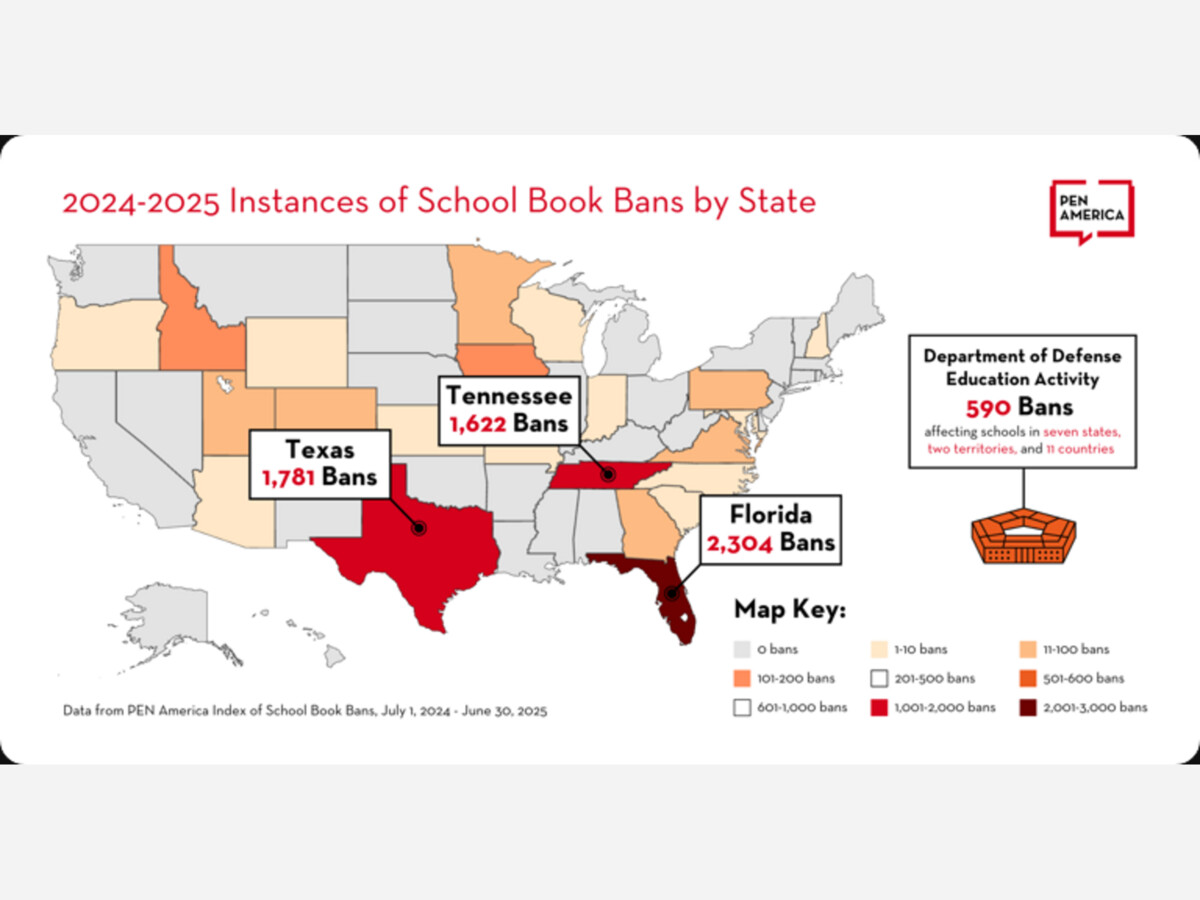
PEN America, which focuses specifically on public-school book bans, reported this week that 11,982 instances of book bans occurred during the 2025-26 school year, involving 7,370 unique titles.
According to PEN America, both figures are the highest it has recorded since it began tracking school book bans in 2021. The organization also reported that 114 school districts banned books during the 2025-26 school year.
The ALA's numbers differ because it tracks challenges and censorship attempts in public, school, and academic libraries, not only school bans. Its 4,235 challenged titles in 2025 therefore should not be directly compared with PEN America's 7,370 titles banned during the 2025-26 school year. The two organizations are measuring different things.
The issue is especially relevant in Lake Forest Park and Shoreline, where the King County Library System and the Lake Forest Park Library Advisory Committee have promoted reading and community literary programs.
The Lake Forest Park, Richmond Beach and Shoreline libraries continue to participate in the annual READS program, which brings residents together around a common book. The Friends of the Lake Forest Park, Richmond Beach and Shoreline Libraries, the Lake Forest Park Library Advisory Committee, and Third Place Books sponsor the program.
The Washington State Library is also participating in this year's discussion. The Washington Center for the Book has partnered with the Washington chapter of Authors Against Book Bans on a video series featuring Washington authors discussing what it means to read and write freely. The series includes authors writing for children, young adults and adults.
Among the participating authors is Washington writer Kelly Jones, whose book Unusual Chickens for the Exceptional Poultry Farmer was challenged and temporarily removed from school shelves in Florida. Jones, a former children's librarian, has spoken about the experience as part of Washington's WA Reads Freely project.
For parents, teachers, librarians and school officials, the question isn't necessarily whether every book belongs in every school or library.
Rather, the debate involves how decisions should be made when someone objects to a particular book.
Parents can guide what their own children read. Schools and libraries have collection policies and review procedures. Communities can discuss whether particular materials are appropriate for particular ages and educational settings.
The larger question raised by Banned Books Week is what happens when a request goes beyond limiting one child's access and seeks to prevent other children from accessing the same material.
That question has no simple answer.
But in Washington, as elsewhere, the debate continues in school board meetings, libraries, classrooms, and communities.
And for Banned Books Week, that may be the central point: the conversation about what we read—and who decides what we can read—is itself an important part of a community's civic life.

Sunny, with a high of 67 and low of 47 degrees. Fog in the morning, sunny in the afternoon, clear in the evening, mist overnight.



This is really well done and should be read by everyone who will vote on the property tax levy lid increase in our upcoming election. I hope every LFP council member has already read it and understands it.
I'm impressed with the analysis but I didn't see any attribution so am curious to know whether this was written by a human or generated by AI.
Both.