49° and Overcast



Image
Opinion | Iko Knyphausen | July 13th, 2026
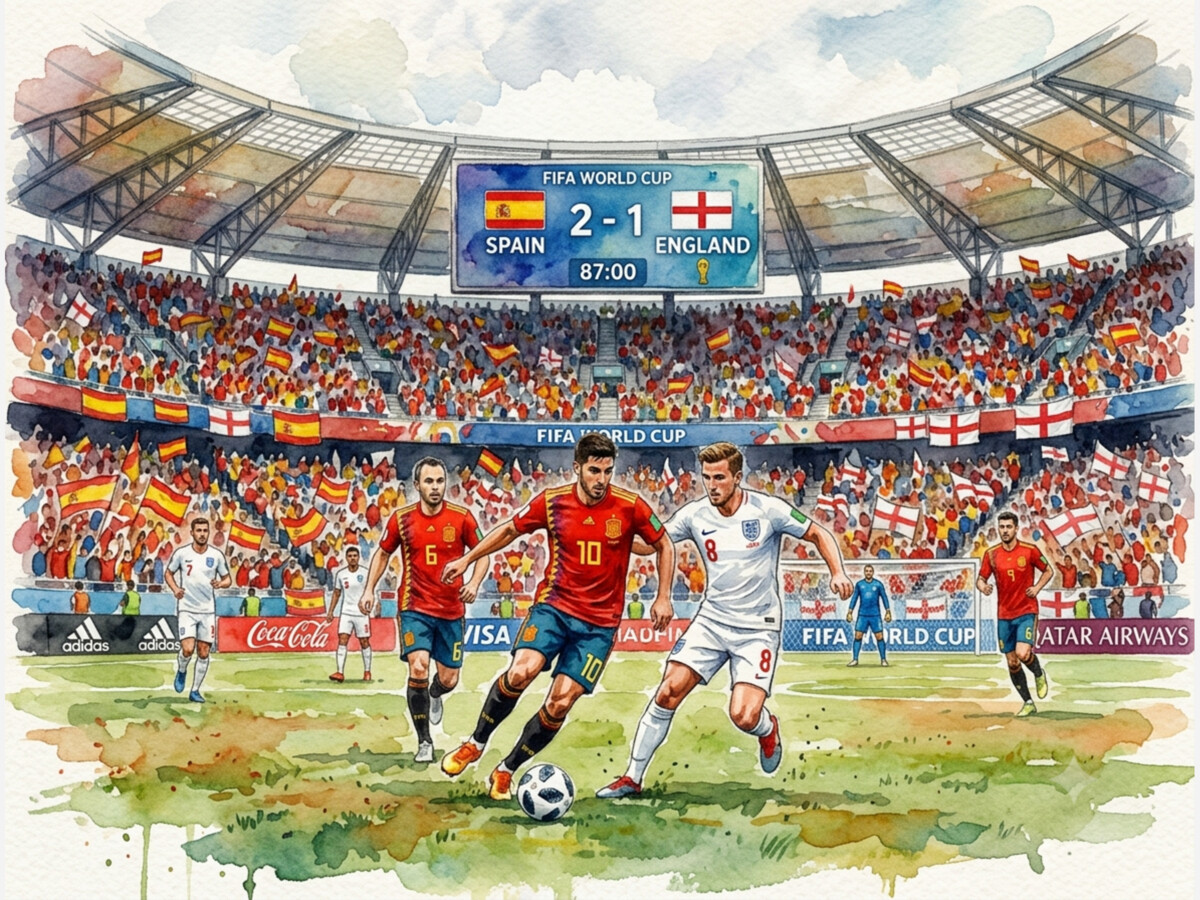
Vozinha’s mother watched her son keep a clean sheet against Spain from thousands of miles away, because the country hosting the world’s biggest sporting event had asked a working goalkeeper’s family for a fifteen-thousand-dollar bond before letting her into the country.1 The Cape Verde goalkeeper went on camera afterward, teary-eyed, describing the empty seat where his mother was supposed to be. Fans on three continents noticed. A GoFundMe campaign filled within days, a member of Congress intervened to expedite the visa, and by the time Cape Verde met Uruguay, Ana Candida Evora had her seat.2 That is the tournament working exactly as advertised: strangers becoming invested in a fifty-nine-year-old house cleaner they will never meet, because her son made history defending his goal. The same pull — a little pun intended here — comes from watching Norway row to the quarterfinals, a motion, supported by drumbeats, that became one of the tournament’s signature images, and the team’s furthest advancement in World Cup history.3 Just like Cape Verde, Norway had a great run and, in the process, won many new followers. In a flurry of support for the well-performing underdogs, both teams’ jerseys flew off the shelves. Just like JFK once famously stated that he was a “Berliner”, soccer fans swore new allegiances to these teams. I suspect most people reading this have their own version of one story or another. That pull is real and worth defending. It is also a separate question from who is cashing the checks the tournament generates, and it is that second question I want to spend the rest of this article on, with two semifinals and a final still ahead.
The scale of the money involved has stopped being a sports story and has become a macroeconomic one. FIFA’s four-year commercial cycle running through this tournament is on pace for roughly 13 billion dollars in revenue, a 72% jump over the 7.57 billion generated in the Qatar cycle.4 Broadcasting rights remain the largest single stream, projected above 4.2 billion dollars for 2026 alone, with United States media rights up roughly ninety-four percent over Qatar.5 Sponsorship sold out every one of FIFA’s sixteen global partner slots for the first time in the tournament’s history, a haul analysts expect to exceed 2.4 billion dollars.6 Ticketing and hospitality, boosted by FIFA’s first use of dynamic, uncapped pricing, is the fastest growing line of all, projected near three billion dollars, a 216 percent increase over Qatar.7 None of that money moves through a body any electorate has a vote over.
The revenue growth in this cycle is real, but the more consequential shift is in who actually receives the money. For most of the tournament’s history, a local organizing committee absorbed the costs of hosting and shared in whatever upside there was. In 2026, for the first time, FIFA is running the tournament itself, dealing directly with host cities rather than through national federations, and it controls essentially all of the revenue, from media rights and sponsorship to ticketing, hospitality, and merchandise, while the cities whose names are on the marquee control the costs.8 It is, in the words of one economist who has studied the arrangement, a franchise model in which the franchisees pay to operate the business and the franchisor keeps the receipts.9
Seattle is as good a window into this as any host city, partly because it is one of the few whose contract terms became public. Lumen Field belongs to the public, a fact that surprises people who assume Seahawks ownership extends to the building itself. It was created by a 1997 voter referendum as the Washington State Public Stadium Authority, and it is operated under a long-term lease by First and Goal Inc., the company representing the Seahawks’ ownership.10 For the fifty-nine days of FIFA’s exclusive-use period at Lumen Field, thirty days before Seattle’s first match and seven after its last, spanning the full run from June 15 to July 6, the stadium’s owner and operator see none of the ticket revenue from the six matches played there.11 First and Goal receives a negotiated rental fee instead, and Seattle’s released contract actually spells that fee out in detail: a schedule setting day rates of $812,980.63 for a match day and $73,549.03 for a non-match day, which works out to roughly $8.78 million across the six match days and fifty-three non-match days in that window.12 That level of disclosure isn’t universal: Houston and Dallas redacted their equivalent rental figures even after a Texas court forced the broader contracts into public view.13 The decision to disclose or withhold that number is evidently a local one, made independently by each host city rather than dictated uniformly by FIFA. The one piece of matchday revenue the stadium keeps regardless is concessions, which is presumably why thirteen-dollar pretzels became a local news story while the far larger sums moving through the building did not.14
Washington State put roughly 46.6 million dollars of public money into World Cup preparation, 19.4 million of it toward stadium upgrades that will outlast the tournament and benefit Seahawks and Sounders games for years afterward, a genuine if modest legacy asset.15 The tourism case for the rest of it has softened as the actual numbers have come in. Visit Seattle’s original projection of 929 million dollars in economic impact was revised down to roughly 845 million by May, about ninety-one percent of the original estimate, after nearly eighty percent of surveyed regional hoteliers reported bookings lagging behind forecasts.16 That 845 million figure is also the wrong number to weigh against the public outlay, because it is a gross spending estimate built on an economic multiplier, not a measure of net benefit. Some of it is money that would have moved through Seattle’s economy on a different weekend regardless, and much of what does count as new spending leaves the region the moment it reaches a hotel chain headquartered elsewhere. The number that actually belongs on the public ledger is smaller: the same projections point to roughly 95.8 million dollars in new state and local tax revenue, against a regional public spending tally that has already climbed past 120 million dollars once every agency’s contribution is counted, not just the 46.6 million the state legislature appropriated up front. On the narrowest and most favorable accounting available, before any discount for the kind of inflated multiplier effects economists have flagged in this literature for decades, Seattle is projected to spend more than it collects.16 The same pattern shows up in host city after host city, and it has a long history. Research from the University of Toronto found that twelve of the last fourteen World Cups produced net economic losses for their host regions, and a German economist who has published more than a dozen studies on World Cup economics specifically has made the point that once academics examine the data after the fact, the large pre-tournament numbers largely vanish, and whatever effects remain are very small and very short-lived.17
If the economics are this consistently unfavorable, the natural question is why cities keep bidding? The literature on that is fairly settled. Bidding functions as a kind of auction, and the winning bid tends to come from whoever most overestimates the benefit, or most underestimates the cost, a dynamic economists call the winner’s curse.18 Construction firms, hospitality interests, and the law and investment banking firms that float the bonds are consistent winners regardless of the aggregate civic outcome, and they lobby accordingly, while the costs land on a taxpayer base with far less capacity to organize against a bid than a construction lobby has to promote one.19 Layered on top of that is straightforward political prestige, the desire of a country’s leadership to showcase its standing on the world stage, a motive researchers trace back at least to Germany’s 1936 Olympics and one that shows up plainly in Qatar’s roughly 200 billion dollars in World Cup preparation spending against IMF estimates of 2.3 to 4.1 billion in actual short-run economic gain.20 Bonita Mersiades, who worked on Australia’s bid for the 2018 and 2022 tournaments before becoming a FIFA whistleblower, watched that incentive structure up close: delegations spent tens of millions of dollars less on football infrastructure than on consultants, favors, and gifts aimed at the two dozen men who then controlled the host vote, everything from stadium funding routed to a voting member’s home federation in Trinidad and Tobago to pearl necklaces handed out at a bid dinner in Sydney.21 Myles Coleman, who wrote and produced Netflix’s FIFA Uncovered, ties the same instinct to what he calls the reflected glory of sport to burnish their own reputations, the logic that explains why the value of hosting so rarely tracks the economics.22
None of this would be quite so galling if the organization collecting the money were subject to ordinary disclosure requirements. It is not. FIFA Uncovered, Netflix’s 2022 documentary on the federation’s history, opens with the observation that being a member of FIFA is like being in a secret garden, governed by an unwritten code that lets insiders do as they please, and the legal structure underneath that image is real.23 FIFA is registered as a non-profit association under Swiss civil law, the same legal category used by roughly fifty Switzerland-based sports bodies including the International Olympic Committee, and associations in that category are not obliged to register with the state or publish their accounts.24 Zurich’s cantonal government considered a motion to require any entity with turnover above one billion Swiss francs to pay standard corporate tax rates, a threshold FIFA’s revenue had tripled, and rejected the motion anyway.25 One Zurich lawmaker said plainly that it is a mystery how FIFA can be described as a non-profit association, and that nobody on the street understands it.26 Switzerland’s Green party has called FIFA a profit machine rather than a non-profit, and pushed to have its tax privileges revoked outright.27 FIFA does publish an annual report with cycle-level revenue and expense totals, which is where most of the figures in this piece come from, but that reporting stops well above the level of detail that would let a taxpayer in any host city see what their own stadium was paid, or by whom, or under what terms.28 Mersiades offers a more recent verdict on that opacity. FIFA now publishes its bidding documents and lets the full Congress vote rather than a closed committee of two dozen, and by her account, it is still not a lot more transparent, pointing to Saudi Arabia’s uncontested 2034 award as a vote that looked democratic and functioned, in her telling, like a decision made by one person.29
The part of this tournament’s finances that has drawn the most direct fan anger, and the most direct legal exposure, is the ticket market. FIFA introduced demand-based dynamic pricing for the first time this cycle and paired it with an uncapped official resale exchange, on which it collects a 15% commission from the seller and another 15% from the buyer, for a combined 30% on every transaction.30 The Department of Justice settled with Ticketmaster in March over service fees, capping them at fifteen percent, half of what FIFA charges on the same kind of trade.31 Resale listings for the final at MetLife Stadium briefly exceeded two million dollars for a single seat.32 Mexico, where resale law is stricter, secured a commitment from FIFA to cap resale at face value, a concession American fans were never offered, which rather undercuts the standard explanation that prices simply reflect the market rate for a global audience.33 Attorneys general in New York, New Jersey, California, and Texas have since opened investigations or issued subpoenas. One economist noted seat inventory disappearing from FIFA’s own primary marketplace in patterns inconsistent with ordinary fan resale, before resurfacing on secondary platforms at lower prices. New Jersey’s attorney general described the buying process in terms about as blunt as a state official gets, calling it a gauntlet of confusion, fake scarcity, and impossibly high prices.34
Two semifinals and a final remain, and I have no intention of guessing at how they go. What I will say is that the tournament ends in a little over a week, but the machine will go on. The love for the sport runs deep, and it runs across all socioeconomic boundaries. The Hollywood elites that have Sir David Beckham on speed dial, and the children juggling a taped-up ball on a dirt pitch in the favelas, chasing the dream, of becoming the next Pelé, Maradona, Ronaldo, Messi, or Neymar — all of whom have come from poor backgrounds — they all share the same unifying love for the sport. That part of the game was never Zurich’s to own, or FIFA’s, or any boardroom’s. It belongs to whoever shows up for it, and for one more week, it still belongs to everyone at once. Money and politics have poisoned many aspects of our lives, but in soccer, the love for the game might be able to defend against it.


Sunny, with a high of 68 and low of 41 degrees. Sunny in the morning, overcast in the afternoon and evening, clear overnight.




This is really well done and should be read by everyone who will vote on the property tax levy lid increase in our upcoming election. I hope every LFP council member has already read it and understands it.
I'm impressed with the analysis but I didn't see any attribution so am curious to know whether this was written by a human or generated by AI.

Both.