53° and Clear
Image
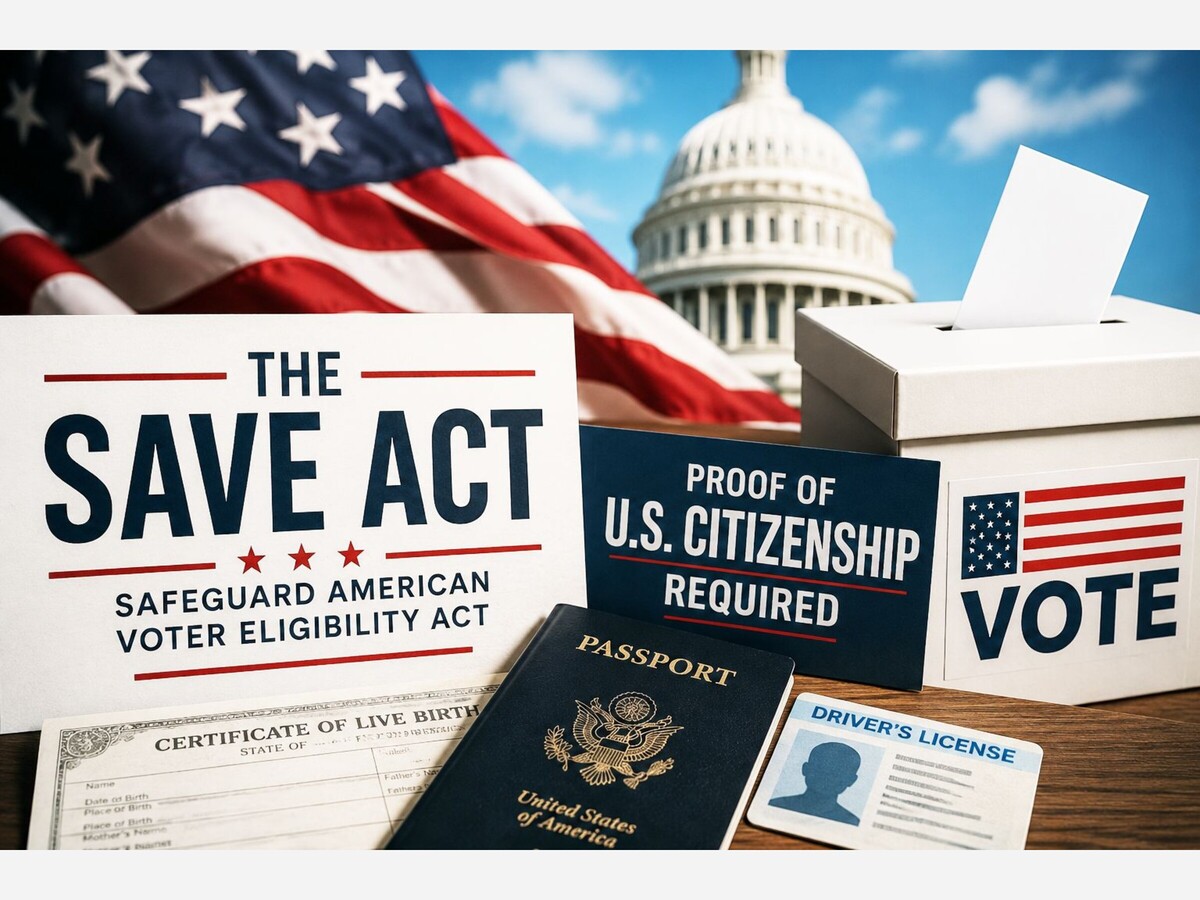



WASHINGTON — A fierce legislative battle over how Americans register to vote is playing out on Capitol Hill. At the heart of the storm is the Safeguard American Voter Eligibility (SAVE) America Act.
Passed by the House of Representatives in February 2026, the Republican-backed bill would fundamentally alter the registration process by requiring individuals to present documentary proof of U.S. citizenship (DPOC) in person.
While proponents frame the measure as a critical safeguard for the integrity of U.S. elections, opponents warn it could unintentionally lock millions of eligible American citizens out of the democratic process.
Supporters of the SAVE America Act, led by congressional Republicans and heavily championed by President Donald Trump, argue that the bill closes a dangerous gap in the current voting system.
"To me, the issue here is... opposing something that’s popular across this country, not just with Republicans, but with Democrats as well."
— Senate Majority Leader John Thune (R-SD)
Democrats, civil rights groups, and voting rights advocates strongly oppose the legislation. They argue the bill is a "solution in search of a problem" that would disproportionately impact vulnerable populations.
Nonpartisan research organizations have sought to evaluate the claims made by both sides:
| Issue | Republican / Proponent Claim | Democratic / Opponent Claim | Nonpartisan Research / Data Findings |
| Prevalence of Non-Citizen Voting | It is a growing risk that threatens the validity of federal elections. | It is extremely rare and already carries strict criminal penalties. | Rare: Studies consistently show that non-citizen voting is statistically minuscule, as the penalties (prison time, deportation) serve as major deterrents. |
| Impact of Rules on Voter Turnout | Security measures do not stop eligible voters from casting ballots. | The rules will block tens of thousands of eligible citizens. | Evidence of Friction: When Kansas implemented a similar state-level law, it temporarily blocked roughly 31,000 eligible citizens (12% of applicants) from registering. |
The SAVE America Act currently faces a steep uphill climb in the Senate, where Republicans lack the 60 votes required to bypass a Democratic filibuster. Under intense pressure from President Trump, some Republican lawmakers are exploring avenues to pass the bill through the budget reconciliation process.
Meanwhile, the battle has shifted to state capitols. Since the 2024 election, at least seven states—including Ohio, South Dakota, Utah, and Wyoming—have passed state-level laws requiring documentary proof of citizenship for voter registration.
As the 2026 midterms approach, the tension between maximizing election security and preserving voter access remains one of the most defining and polarizing debates in American politics.



Sunny, with a high of 68 and low of 47 degrees. Fog during the morning, sunny for the afternoon, clear during the evening, mist overnight.





This is really well done and should be read by everyone who will vote on the property tax levy lid increase in our upcoming election. I hope every LFP council member has already read it and understands it.
I'm impressed with the analysis but I didn't see any attribution so am curious to know whether this was written by a human or generated by AI.
Both.