50° and Light drizzle



Image
Opinion | Iko Knyphausen | June 29th, 2026
Two Supreme Court rulings issued last week reshape how the United States treats people seeking protection at its borders. To understand what changed, it helps to understand what the law was designed to do, and where that design quietly broke down over thirty-five years.
On the morning of June 25, 2026, the Supreme Court issued two 6-3 rulings on immigration, both written by Justice Samuel Alito, both decided along the court’s conservative-liberal divide. Together, they answer a question that has been building since 1990: what happens when a temporary legal instrument meets a permanent humanitarian crisis?
The short answer the court provided is: the temporary instrument wins. To understand why that answer is both legally coherent and practically consequential, it is necessary to go back to the statute itself.
Temporary Protected Status was created as part of the Immigration Act of 1990, signed by President George H.W. Bush.1 The design was straightforward: when a country experiences an armed conflict, an environmental disaster, or other extraordinary conditions that make return unsafe, the United States government can designate that country for TPS. Nationals of that country who are already present in the United States receive three things: a registration document, authorization to work, and protection from deportation for the duration of the designation.2
What TPS does not provide, and has never provided, is a path to permanent residency. This was not an oversight. The statute contains an explicit procedural barrier against any legislation that would allow TPS recipients to adjust to lawful permanent resident status, and any Senate attempt to waive that barrier requires a three-fifths supermajority.3 The wall between temporary protection and permanent status was deliberate. It was the political price of getting the program passed at all.
TPS was also created to fill a specific gap. Before 1990, the government had used an informal mechanism called Extended Voluntary Departure, or EVD, to let nationals of certain troubled countries remain in the United States. But EVD was entirely discretionary, applied inconsistently, and offered no statutory standards.4 TPS replaced that ad hoc practice with a formal statutory procedure, including a required interagency review of country conditions before any designation could be made or terminated. That procedural requirement would become central to today’s litigation.
The first country designated under the new statute was El Salvador, whose civil war had displaced hundreds of thousands of people. Congress acknowledged at the time that the United States, which was providing military aid to El Salvador, bore a particular responsibility not to return Salvadorans to a conflict its own foreign policy was sustaining.5 The program was designed around an assumption: that emergencies resolve, that crises pass, and that people would eventually return home.
Some crises did not pass. El Salvador’s TPS designation expired in 1992, but conditions had not improved. President Bush extended relief through a different mechanism. President Clinton extended it further. When two major earthquakes struck El Salvador in January and February of 2001, the country was re-designated for TPS, and that designation has been continuously renewed for more than twenty-four years.6 Honduras received TPS after Hurricane Mitch devastated the country in 1998 and has been continuously designated for more than twenty-five years. Haiti received TPS in 2010 following a magnitude 7.0 earthquake that killed more than 300,000 people.
By March 2025, approximately 1.3 million people held TPS from seventeen designated countries, according to U.S. Citizenship and Immigration Services data.7 Some had been in the United States, lawfully, for decades.
The statute was designed around an assumption: that emergencies resolve, that crises pass, and that people would eventually return home. Some crises did not pass.
This created what immigration scholars have called a legal limbo. TPS holders could live and work legally in the United States, pay taxes, raise families, and build careers, but they could not convert that lawful presence into permanent status, no matter how long the designation lasted or how many times it was renewed.8 They were neither undocumented nor secure. Each renewal brought another 6 to 18 months of stability, and each renewal cycle brought another round of uncertainty.
Congress was aware of this problem. Legislation that would allow long-term TPS holders to adjust to permanent resident status has been introduced in multiple Congresses, including the American Promise Act, which would have allowed adjustment for TPS holders present in the United States before January 2017. None has passed.9 The statute’s built-in supermajority requirement for any Senate bill creating a path to permanent status means that even a simple majority is not enough to legislate a fix.
Haiti’s TPS history illustrates the gap between the statute’s design and its application with particular clarity. The 2010 earthquake designation was repeatedly extended across successive administrations. In 2021, following the assassination of the Haitian president and the subsequent collapse of governmental order, the Biden administration redesignated Haiti, extending TPS to a new wave of Haitian nationals who had arrived after the original 2010 cutoff.
In 2025, the Department of Homeland Security announced the termination of Haiti’s TPS designation. In its own filing, DHS acknowledged that “certain conditions remain concerning, especially gang violence and its spillover effects,” while asserting that certain areas of the country were suitable for return and that the situation would improve with the deployment of a multinational gang-suppression force.10 The State Department’s current travel advisory for Haiti is Level 4: Do Not Travel, its highest warning, applied to active conflict zones.11
Haitian TPS holders challenged the termination on two grounds. First, they argued that the administration had failed to conduct the required interagency review of country conditions before terminating the designation. Documents produced during litigation and reported by advocacy groups alleged that the review process was bypassed or its conclusions set aside.12 DHS disputed those characterizations. Second, plaintiffs argued, and the dissenting justices agreed, that the termination was tainted by racial animus, a claim grounded in the legal record compiled during litigation rather than in campaign statements alone.13
Last week, in Mullin v. Doe, the Supreme Court addressed the TPS terminations for Haiti and Syria. The majority held that the TPS statute bars judicial review of non-constitutional challenges to the Secretary’s termination decisions, meaning that procedural claims, such as failure to conduct the required interagency country-conditions review, cannot be heard in federal court.14
The ruling does not eliminate all judicial review. Constitutional claims, including equal protection, due process, and race-motivated government action, remain justiciable in principle. The majority found, however, that the Haitian plaintiffs were unlikely to prevail on their equal protection claim at this stage of litigation.15 Justice Elena Kagan, in dissent, joined by Justices Sotomayor and Jackson, wrote that the law prevents the program from ending as it likely did here, without the required consultations about country conditions and with what she described as constitutionally impermissible considerations tainting the Haiti decision.16
The ruling takes effect in 32 days, barring any further district court action. It affects approximately 350,000 Haitian nationals and roughly 4,000 Syrians immediately, according to figures cited in the litigation.17 The legal precedent on judicial review could affect TPS holders from all seventeen currently designated countries as their designations come up for renewal, including more than 600,000 Venezuelans, approximately 195,000 Salvadorans, and around 50,000 Ukrainians, based on USCIS enrollment data.18
Who is affected? As of March 2025, approximately 1.3 million people held TPS from 17 countries (USCIS). Today’s ruling clears the way for the removal of roughly 350,000 Haitians and 4,000 Syrians, with similar exposure for more than 600,000 Venezuelans, approximately 195,000 Salvadorans (some continuously protected for more than 25 years), and around 50,000 Ukrainians as designations come up for review. Enrollment figures are drawn from USCIS and CRS data; exact current counts are subject to ongoing administrative changes.
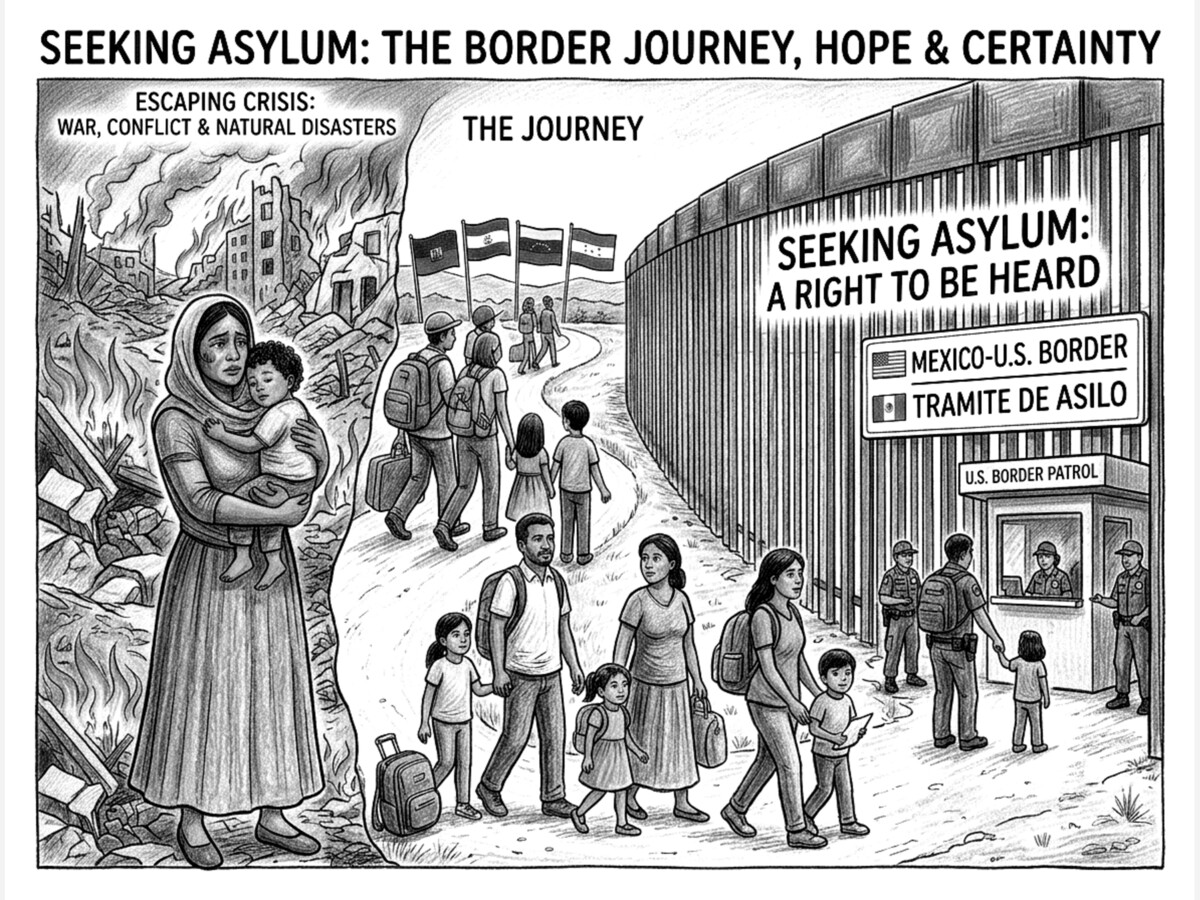
The second ruling, Mullin v. Al Otro Lado, addressed when a person arriving at the U.S.-Mexico border acquires the right to apply for asylum.
Under U.S. law, a person may apply for asylum if they are “physically present in the United States” or if they “arrive in the United States.”19 The question before the court was whether a person who presents themselves at a port of entry and requests admission has “arrived” for purposes of asylum eligibility, even if border officials prevent them from physically crossing the line.
The policy at issue, known as metering, was first used during the Obama administration and expanded during the first Trump administration. The metering policy is a U.S. Customs and Border Protection (CBP) practice that limits the number of asylum seekers who can present themselves at designated Ports of Entry along the U.S.-Mexico border. Under metering, Customs and Border Protection officers station themselves at the physical border line and turn away people who appear to be asylum seekers before they can step onto U.S. soil. A Department of Homeland Security Office of Inspector General report found in 2020 that CBP officers had, in reported instances, turned away asylum seekers despite available processing capacity, and the agency’s own records included testimony alleging that officers were directed to misrepresent capacity to those seeking entry. CBP disputed aspects of those findings.20
The court ruled 6-3 that physical entry is required for asylum eligibility. A person still standing in Mexico has not “arrived in the United States” within the meaning of the statute, and border officials are not obligated to process asylum claims until a person is on U.S. soil.21 The ruling revives the legal foundation for metering. Whether and how the administration reinstates the practice will depend on agency decisions, available processing capacity, and operational conditions at individual ports of entry.
Challengers had argued that this interpretation creates a perverse incentive: if presenting at a port of entry confers no asylum rights, people who might otherwise have sought protection through lawful channels have reason to cross the border between ports of entry, where physical presence on U.S. soil does trigger asylum eligibility. The majority acknowledged the argument but found it insufficient to override the statutory text.22
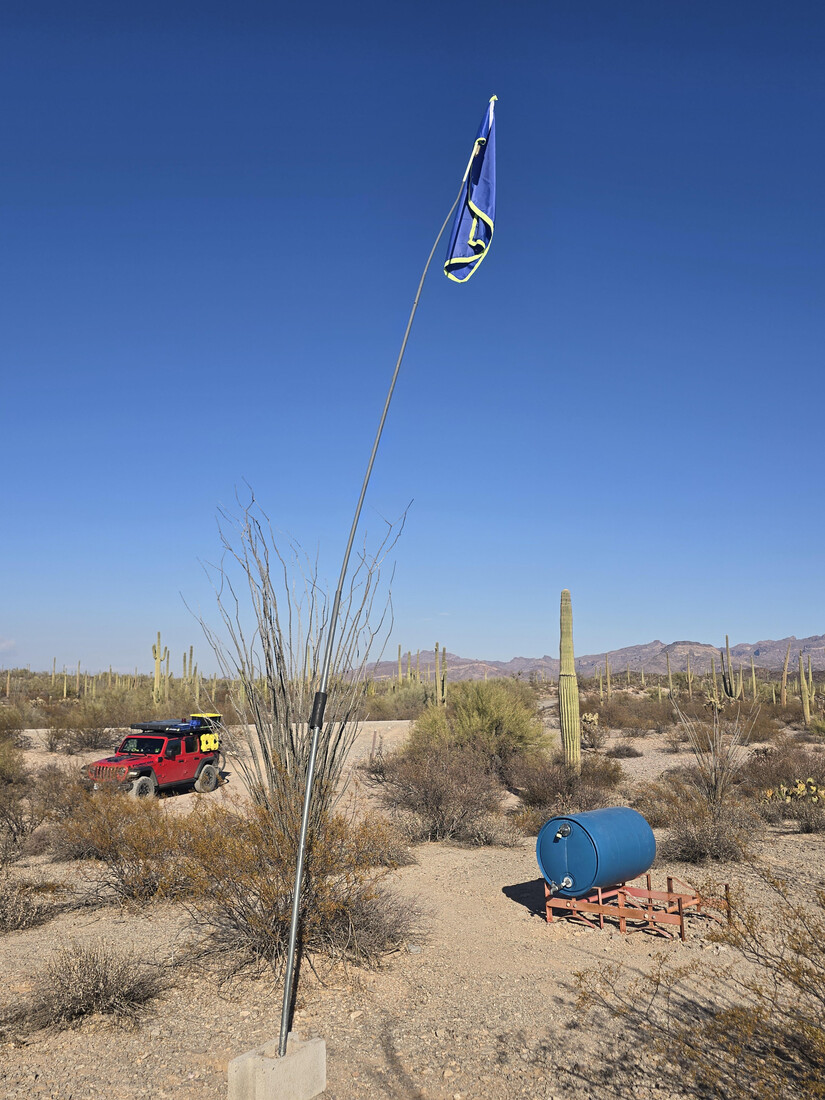
Water station near the Sonoran Desert in Arizona, provided by HumaneBorders.org. Photo by Chris Clasen.
The court also addressed the 1951 Refugee Convention’s non-refoulement principle, which prohibits returning refugees to territories where they face persecution. The majority held, consistent with its 1993 precedent in Sale v. Haitian Centers Council, that the Convention’s Article 33 applies to persons within U.S. territory and does not govern actions taken toward individuals outside U.S. borders.23 This reading is contested in international law. The prevailing view among international legal scholars and the United Nations High Commissioner for Refugees holds that non-refoulement attaches based on a state’s effective control over a person, not solely on their physical location relative to a border line, a distinction the majority declined to adopt.24
What now? The TPS ruling takes effect in 32 days absent further court intervention. Plaintiffs retain the ability to pursue constitutional claims in district court, including equal protection challenges, though the majority’s assessment of those claims at this stage is discouraging for that avenue. Congressional action remains the other path: legislation could create a statutory adjustment mechanism for long-term TPS holders, but clearing the Senate’s built-in supermajority barrier for any such bill is a high threshold. The American Promise Act and similar measures have not advanced in recent sessions.
For those directly affected, immigration attorneys and advocacy organizations are advising TPS holders to preserve all documentation of their status and employment authorization, monitor USCIS and DHS notices closely for compliance deadlines, and consult qualified immigration counsel before the 32-day period expires. Work authorization tied to TPS designations will lapse with the status unless administratively extended.
Both rulings are legally defensible interpretations of the statutes as written. That is precisely the problem. The statutes, as written, reflect decisions made in 1990 and 1996 about circumstances that no longer align with the reality of the program as it has been administered for three and a half decades.
TPS was designed as a short-term humanitarian bridge, not a long-term immigration status. The people affected by last week’s ruling did not create that mismatch. They arrived, in most cases lawfully, under a program the government repeatedly renewed. They built lives, paid taxes, raised children who are U.S. citizens, and worked in sectors including healthcare, construction, and food services. The statute that protected them never promised permanence, but it also never provided a mechanism for converting years of lawful presence into something more durable.
Congress has had thirty-five years to address this. That unresolved legislative question has now been resolved by the Supreme Court, on the narrowest reading available under existing law.
What the rulings do not change is the underlying condition. Haiti remains at State Department Level 4. Gang violence controls large portions of the country. The people being told their temporary protection is over are being told to return to conditions that the U.S. government’s own assessments describe as unsafe for travel.
The T in TPS has always stood for temporary. The question Congress never answered, and the court was never asked to answer, is what happens when the emergency is not.
Iko can be reached at iko@uw.edu
Notes


Light rain shower, with a high of 55 and low of 45 degrees. Light rain shower during the morning, patchy rain nearby in the afternoon and evening, light drizzle overnight.