


Image
Opinion | Iko Knyphausen | June 22nd, 2026
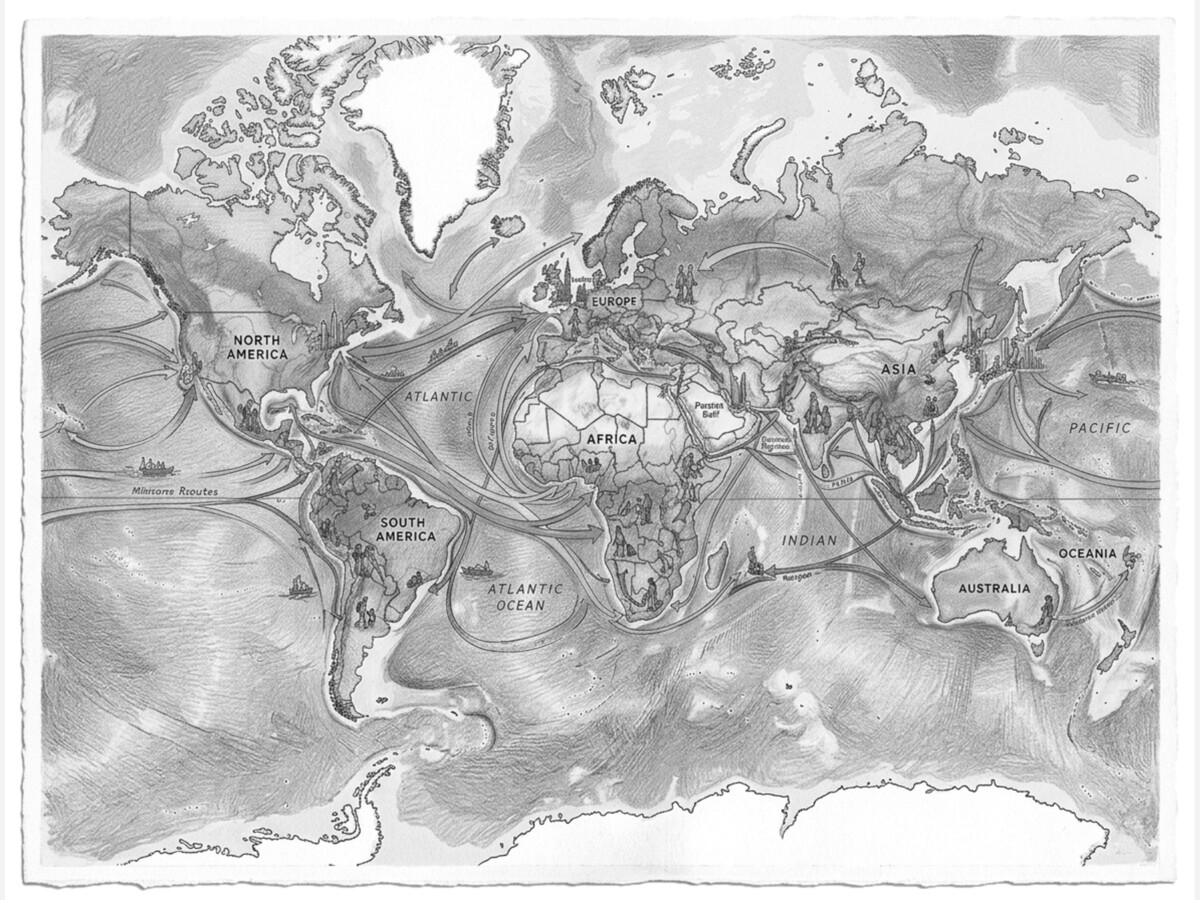
Migration is not a problem to be solved. It is a force to be managed, much like a river: useful when channeled, destructive when ignored, and guaranteed to find its own path regardless of what political leaders say about it at election time. The data tells a story that is considerably more complicated than either the open-borders left or the closed-borders right is willing to acknowledge. Let us try to read it straight.
As of 2024, the world’s migrant population has reached 304 million people.1 That figure includes both voluntary economic migrants and the forcibly displaced. The two groups are governed by different legal frameworks, driven by different causes, and require different policy responses, though in political debate, they are routinely conflated to serve whatever argument is closest at hand.
Within that broader population, forced displacement is at a historic high. By April 2025, the number of people forcibly displaced by persecution, conflict, violence, and human rights violations had reached 122 million, roughly one in every 67 people on earth.2 More than a third of all forcibly displaced people come from just four countries: Sudan, Syria, Afghanistan, and Ukraine. But those four countries are only part of the picture. Gaza’s population faces repeated forced displacement under conditions that UN officials have described as deliberate ethnic cleansing. Lebanon has seen 38 percent of its citizens express a desire to emigrate, a figure that has risen by 12 percentage points since 2018 as economic collapse and deteriorating security have compounded each other.3 Iran has been losing 150,000 to 180,000 educated professionals per year for over a decade, a brain drain so severe that the World Bank estimated its annual cost to Iran at $50 billion, more than twice the country’s oil export revenues at the time of the estimate.4 In West Africa, six countries have experienced military coups since 2021: Burkina Faso, Mali, Guinea, Niger, Gabon, and Chad, each generating additional displacement toward the Mediterranean.5
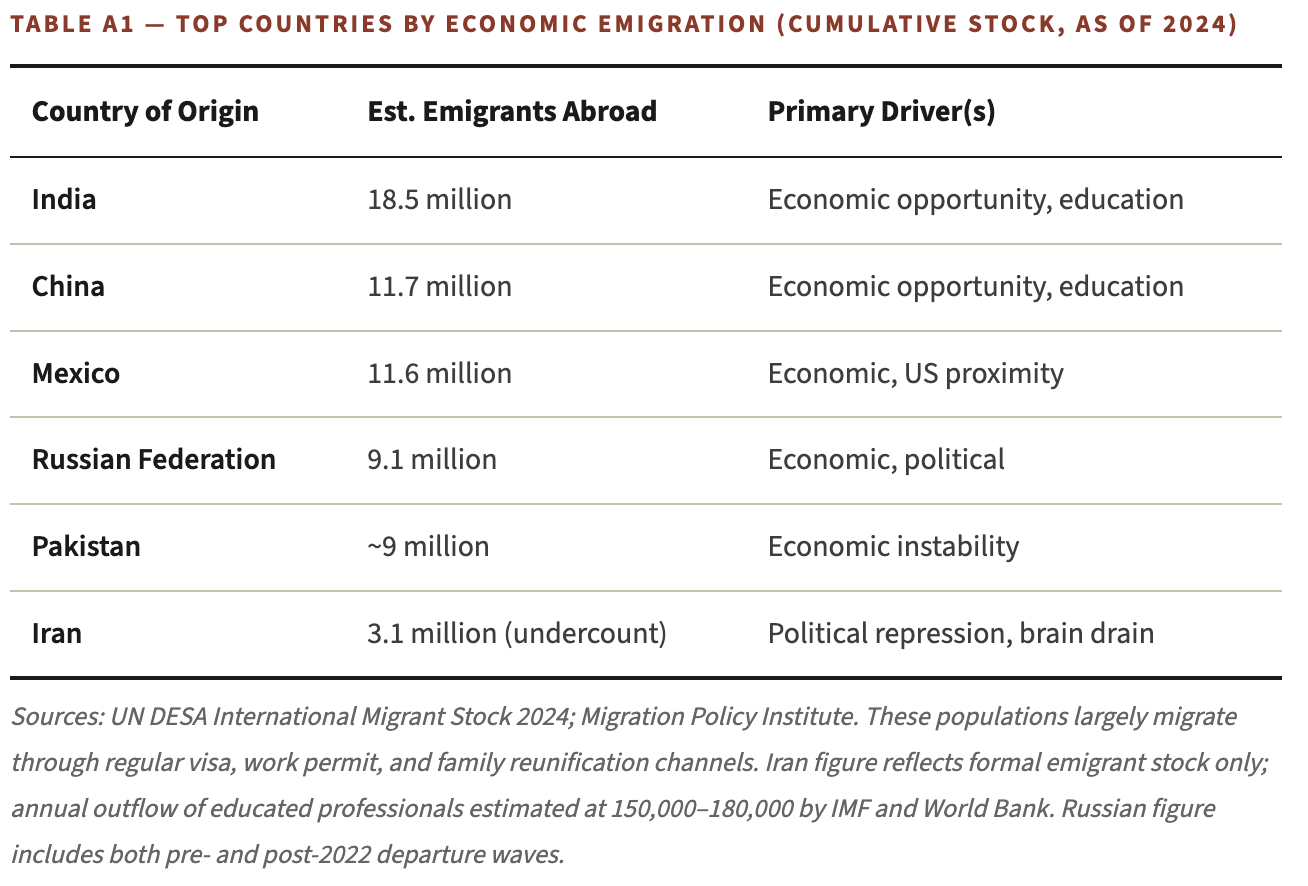
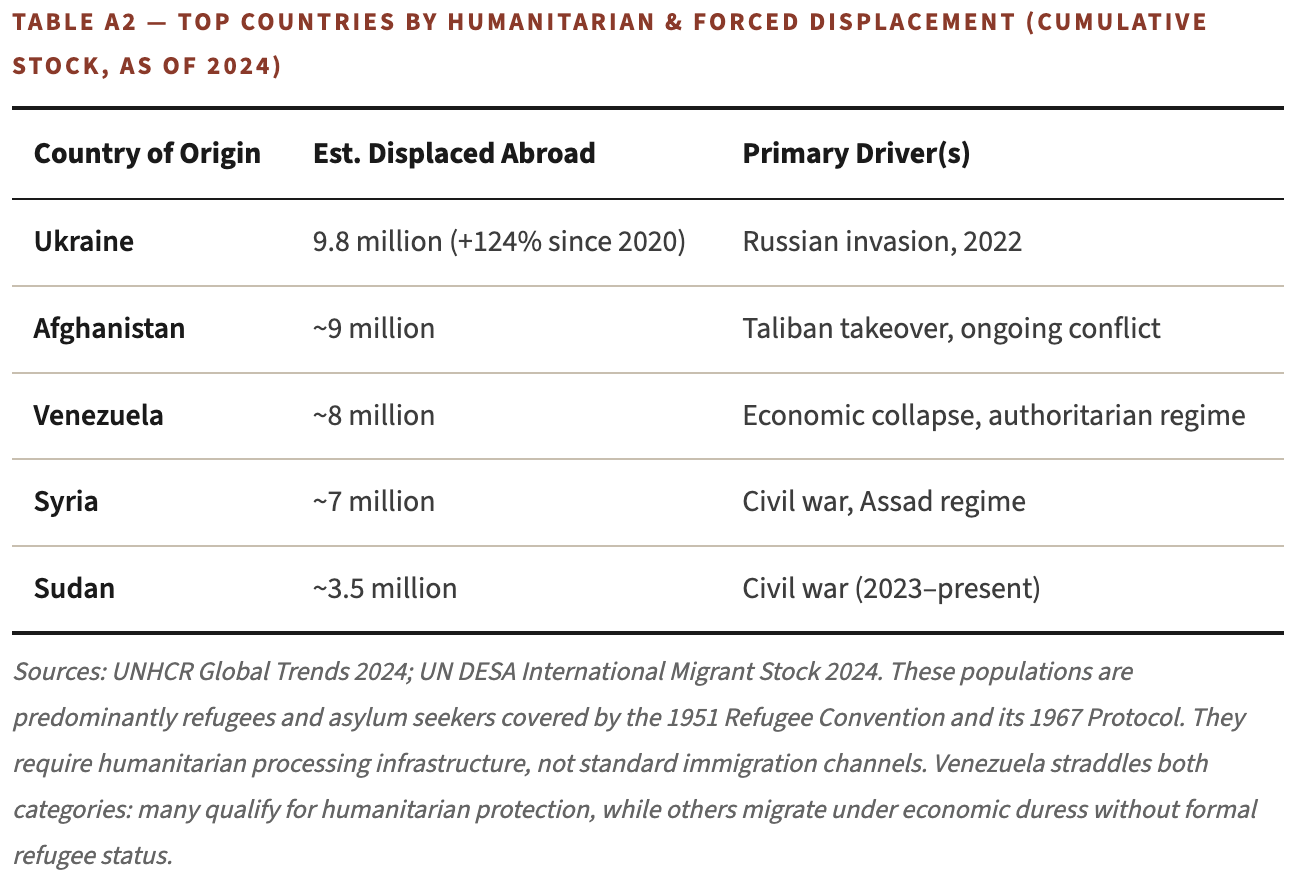
The tables below separate these two populations and show, in absolute terms, where people are leaving from and where they are arriving. The distinction matters: Table A1 covers economic emigrants moving largely through regular channels; Table A2 covers the forcibly displaced, who are subject to an entirely different legal framework.
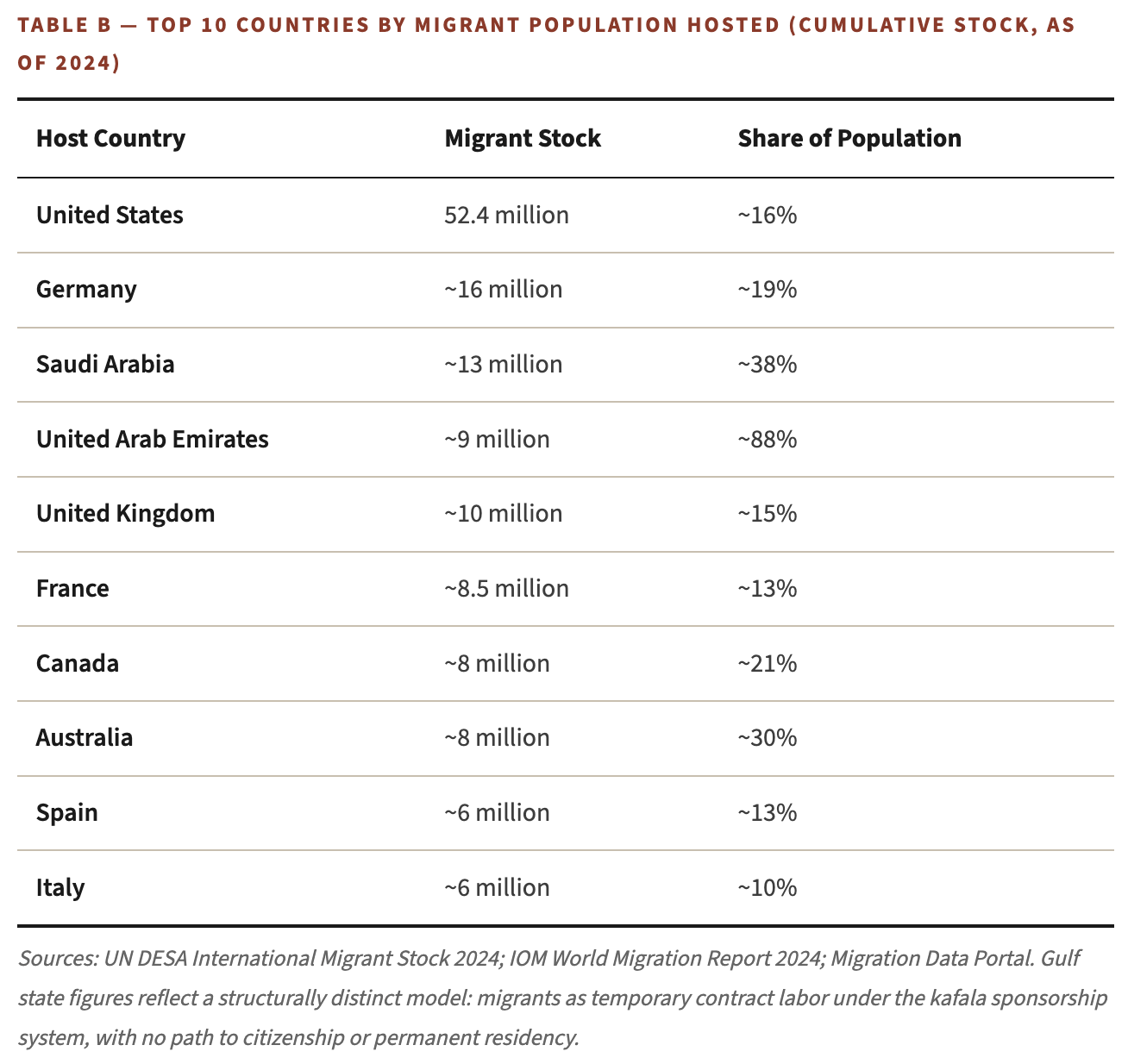
One detail in Table B demands comment. The United Arab Emirates, with migrants constituting 88 percent of its total population, runs a model that is the functional opposite of the European debate: immigration as a fully managed, contractual labor system with no path to citizenship and no pretense of cultural integration. The mechanism is the kafala sponsorship system, under which a migrant worker’s legal status is tied entirely to a single employer. In practice, this has produced systematic wage theft, routine passport confiscation, and the near-total absence of labor protections. Human rights organizations have documented conditions in Gulf construction and domestic work that meet the ILO definition of forced labor. This is not a “different set of ethical problems,” as though it were merely a policy variant. It is a system that makes exploitation structurally legal. The Western debate rarely mentions it, which says something about whose suffering registers in policy circles.
The causes of migration divide into two broad categories that are often blurred: push factors, the conditions that make staying impossible or intolerable, and pull factors, the conditions that make a destination attractive. Political rhetoric focuses almost exclusively on pull factors, suggesting that generous welfare systems, lax border enforcement, or liberal asylum policies are responsible for migration flows. The data does not support this as a primary driver.
The largest contemporary flows are overwhelmingly push-driven. From 2010 to 2020, the four largest bilateral migration corridors in the world were driven by refugee movements, fueled largely by the Syrian civil war.6 The Taliban’s return to power in Afghanistan generated immediate mass flight. The Russian invasion of Ukraine produced the fastest large-scale displacement in Europe since the Second World War. Venezuela’s economic collapse under Maduro, a decline from one of Latin America’s wealthiest nations to one of its most impoverished, has produced approximately 8 million emigrants since 2015. These are not people who looked at a European welfare benefit schedule and decided to leave. They are people for whom staying became untenable.
West Africa adds a more recent and understated chapter. Mali was the leading country of origin for irregular migration to Europe in 2024; Guinea led in 2023. Both reflect growing repression under military juntas.7 Climate change compounds the picture. Rainfall in the Sahel has decreased by over 20 percent since the 1970s, contributing to agricultural collapse and food insecurity, which interact with political instability to produce movement.8 It bears noting, however, that over 70 percent of Sub-Saharan African migrants move to another African country, not to Europe. The panic in Paris and Madrid about “African migration” addresses a phenomenon that is, in absolute terms, considerably smaller than it appears in the headlines.9
A definitional clarification is necessary here because the entire Western debate is distorted by imprecise language. “Irregular migration” and “illegal immigration” are not synonyms, though politicians and media treat them as interchangeable.
The European Commission is explicit: the term “illegal migration” should be avoided, as most irregular migrants are not criminals. Being in a country without the required papers is, in most countries, not a criminal offense but an administrative infringement.10 The International Organization for Migration defines irregular migration as movement that takes place outside the laws, regulations, or international agreements governing the entry into or exit from states of origin, transit, or destination. Crucially, this encompasses three very different populations: those who cross borders without authorization; those who entered legally and overstayed their visas (a category that, in the United States, consistently represents a larger share of the undocumented population than border crossers); and asylum seekers who crossed irregularly but are exercising a legal right under the 1951 Refugee Convention to present themselves and request protection.11
The conflation of these three groups is a rhetorical strategy that allows asylum seekers, who have a legal right to be heard, to be framed as criminals, which then licenses enforcement responses that international law does not permit. When European politicians speak of “stopping irregular migration,” they are often speaking about stopping a legal process, asylum adjudication, by making the journey to initiate it more dangerous.
The more consequential question is not whether migration is happening but under what conditions it tips from a manageable flow into a genuine crisis. The research points to four distinct thresholds, and it matters which one is being crossed.
The first is institutional. The EU itself has now codified this in policy: a crisis occurs when mass arrivals render a member state’s asylum, reception, or return system non-functional.12 This is the clearest definition available, and it shifts the frame usefully. Crisis is not determined by numbers alone but by the ratio of arrivals to processing capacity. A country with robust infrastructure can absorb more migrants without crisis than a country whose bureaucracy is already failing.
The second threshold is structural: housing, healthcare, and public services. Research consistently finds that housing shortages, rising living costs, and pressure on public services are the dominant sources of public concern about migration, with fears of terrorism or violent crime playing a secondary, amplifying role.13 This finding is politically inconvenient for both sides. For the restrictionist right, it suggests that anti-immigrant sentiment is primarily a complaint about domestic policy failures in housing and healthcare, not about the migrants themselves. For the open-borders left, it confirms that rapid inflows without corresponding infrastructure investment do impose real costs on existing residents, particularly working-class communities competing for the same scarce housing.
The third threshold is social cohesion. Germany offers the clearest recent case study. When more than a million people sought asylum in 2015-2016, primarily from Syria, Afghanistan, and the Western Balkans, German society initially responded with what it called Willkommenskultur, a genuinely remarkable welcome culture. After a series of violent incidents on New Year’s Eve 2015-2016, in which some of the perpetrators were recently arrived migrants, public attitudes shifted sharply.14 This shift happened faster and more completely than the underlying crime statistics warranted. But the speed of the shift is itself a data point: large, rapid inflows, particularly from culturally distant populations without structured integration support, create conditions in which any incident, regardless of its statistical significance, can trigger a disproportionate political response. The perceived threat can become politically as consequential as the actual threat.
The fourth threshold is identity, and it is the most contested. The concern that immigration is displacing the cultural, religious, and linguistic character of receiving nations drives the politics of Marine Le Pen, the AfD, and Giorgia Meloni as surely as it drives the American nativist right. It cannot be dismissed as mere xenophobia, though xenophobia often attaches to it. France, with a strong tradition of secular republicanism, has genuine reason to be concerned when a significant portion of arriving populations holds values around gender, sexuality, and the relationship between religion and law that are in direct tension with the Republic’s foundational commitments. Acknowledging this tension honestly is not a concession to the far right. It is a prerequisite for addressing it effectively.
Crisis is not a number. It is a ratio: arrivals over capacity, speed over preparation, difference over integration investment.
The economic case for immigration in the wealthy world is arithmetic. Fertility in OECD countries currently stands at 1.7 births per woman and has been below replacement level since approximately 1980.15 In East Asia and Europe, low birth rates are projected to cause working-age populations to shrink by an average of 11 percent over the next 20 years.16 In the United States, net growth in the labor force since 2008 has been driven almost entirely by foreign-born workers. Those same workers pay into Social Security, sustaining a pay-as-you-go pension system whose beneficiaries are overwhelmingly native-born.17 In 2024, elevated levels of immigration made faster employment growth possible without excessive inflationary pressure by expanding the labor supply.18
History made this argument long before the economists did. West Germany’s postwar Wirtschaftswunder, the economic miracle that rebuilt a destroyed country into Europe’s dominant industrial power within a generation, was built partly on imported labor. Beginning in 1955, the West German government signed bilateral recruitment agreements with Italy, Spain, Greece, Portugal, and eventually Turkey, creating the Gastarbeiterprogramm. At its peak, over 2.7 million foreign workers, nearly 12 percent of the entire labor force, were working in Germany.19 Turkish workers eventually became the largest single group and remain the core of Germany’s immigrant community today. The program contained a structural failure that Germany is still managing: it was designed as temporary, but people who build lives do not leave on schedule. When the oil crisis ended the program in 1973, 2 million of the 14 million workers who had come chose to stay. Germany had not planned for integration because it had told itself the workers were guests.20 They were not guests. They were immigrants, and the country that benefited most from their labor owed them more than it was initially willing to give.
One of the more glaring self-inflicted wounds in the current policy landscape is the Trump administration’s effective dismantlement of the United States Agency for International Development. By March 2025, 83 percent of USAID’s 6,300 global programs had been cancelled. By July 1, 2025, the agency ceased to exist as an independent body.21 The justification was fiscal and ideological: foreign aid does not serve American taxpayers.
The migration data suggests otherwise. USAID programs in Central America specifically discouraged potential migrants from making the journey north, addressing root causes of displacement before they became border encounters.22 The Danish Refugee Council estimates that US aid cuts alone could contribute to an additional 3.95 to 7.85 million people living in displacement in 2025.23 Three other major donors, France, Germany, and the United Kingdom, also cut aid budgets in 2024, potentially combining with the US cuts to produce a 17 percent reduction in global aid spending.24
The arithmetic of the policy reversal is worth sitting with. In the same legislative cycle in which USAID was shuttered, the US Congress allocated more than $170 billion over four years for immigration enforcement. The total USAID budget over the prior four fiscal years was approximately $173 billion.25 The United States has, in other words, chosen to spend roughly the same amount of money stopping migration at the border as it previously spent on fighting the conditions that produce migration in the first place, while abandoning the latter entirely in favor of the former. Prevention has been traded for detention, upstream investment for downstream enforcement.
The policy literature offers a reasonably clear picture of what distinguishes managed immigration from crisis immigration, and it is not primarily about the numbers.
Canada and Australia are the standard reference cases. Both adopted points-based immigration systems, Canada in 1967, Australia in 1979, that select candidates based on skills, language proficiency, age, job offers, and demonstrated likelihood of economic integration before entry.26 This front-loads the integration decision rather than leaving it to a post-arrival scramble. Both countries have revised their systems iteratively over decades as labor market conditions changed, and the result is immigration that tends to generate less social friction not because the immigrants are more culturally similar but because the receiving infrastructure was built alongside the intake policy rather than as an afterthought.
The comparison has limits that are rarely acknowledged. Points-based systems are engineered for orderly, pre-screened economic migration; neither Canada nor Australia faces mass irregular arrivals at a contested land border, the defining structural problem for the United States and Southern Europe. More substantially, these systems have produced what researchers call “brain waste”: foreign-trained doctors, engineers, and scientists who score well on the points matrix and are admitted, then find that domestic regulatory bodies refuse to recognize their credentials. The result is a physician driving a taxi, or an architect working a warehouse floor. Selected for their qualifications, then barred from using them. Points-based admission is a necessary but not sufficient condition; it must be paired with mandatory, time-bound credential recognition reform to deliver on its promise.
By contrast, the United States and most European countries use demand-driven systems that require a job offer before a visa is issued, or they process asylum claims without the resources to clear backlogs, leaving people in legal limbo for years. Legal limbo is not a neutral holding pattern. It produces parallel economies, informal labor markets, housing overcrowding, and the social conditions that generate exactly the visible dysfunction that then feeds anti-immigrant politics.27
The third element is upstream: investment in the political and economic stability of the countries of origin. Conflicts in Syria, Afghanistan, Sudan, and Venezuela did not become migration crises because borders were insufficiently guarded. They became migration crises because millions of people concluded that the risk of the journey was lower than the risk of staying. No border wall addresses that calculation. Only the conditions that drive it do.
Migration, like most large-scale human phenomena, has a ledger with entries on both sides. The credits: immigrants are disproportionately of working age, they start businesses at higher rates than native-born populations, they pay into pension systems that aging native populations depend on, and they have consistently enriched the culture, cuisine, science, and civic life of every country that has received them in significant numbers, including the United States, which was built almost entirely by people who came from somewhere else. The debits: rapid, unmanaged inflows without integration investment impose real costs on existing residents, particularly the poorest native-born workers competing for housing and entry-level employment; sharp cultural discontinuities without mediation create social friction that is then available for political exploitation; and the failure to distinguish between asylum seekers with legal rights and economic migrants without them produces a policy incoherence that satisfies no one and serves no one.
The Western world is currently running its immigration policy as though the ledger has only a debit column. The far right sees only the costs and ignores the structural dependency. The progressive left, at its worst, treats any acknowledgment of the costs as a concession to nativism, which forfeits the argument to the people making it loudest. Neither position is a policy. Both are postures.
A rational immigration policy would look like this: legal pathways scaled to demonstrated labor market needs and demographic realities; a points-based or expression-of-interest system that selects for integration likelihood while preserving humanitarian channels; processing infrastructure funded at the level the intake requires; upstream investment in origin-country stability treated as a security expenditure, not charity; and a clear public accounting that separates asylum law, which is an international legal obligation, from economic immigration policy, which is a legitimate subject for democratic debate.
The river will keep flowing. The only question is whether we are going to build the levees or stand on the bank and argue about the water.
The author can be reached at iko@uw.edu
Endnotes


Overcast, with a high of 59 and low of 44 degrees. Overcast in the morning,




This is really well done and should be read by everyone who will vote on the property tax levy lid increase in our upcoming election. I hope every LFP council member has already read it and understands it.
I'm impressed with the analysis but I didn't see any attribution so am curious to know whether this was written by a human or generated by AI.

Both.