


Image
Current Affairs | Iko Knyphausen | August 20th, 2026
Somewhere in the Gulf of Mexico this week, a barrel of crude oil is having a wonderful time. It cost a refiner about eighty-five dollars, and by the time it comes out the other end as diesel, it sells for nearly two hundred. The refiner pockets the difference, more than a hundred dollars a barrel, a figure so far outside historical norms that the people who track this stuff for a living had to check their spreadsheets twice. Under ordinary conditions, that spread runs in the teens or twenties. It just broke a hundred for the first time since anyone started keeping score. [1]
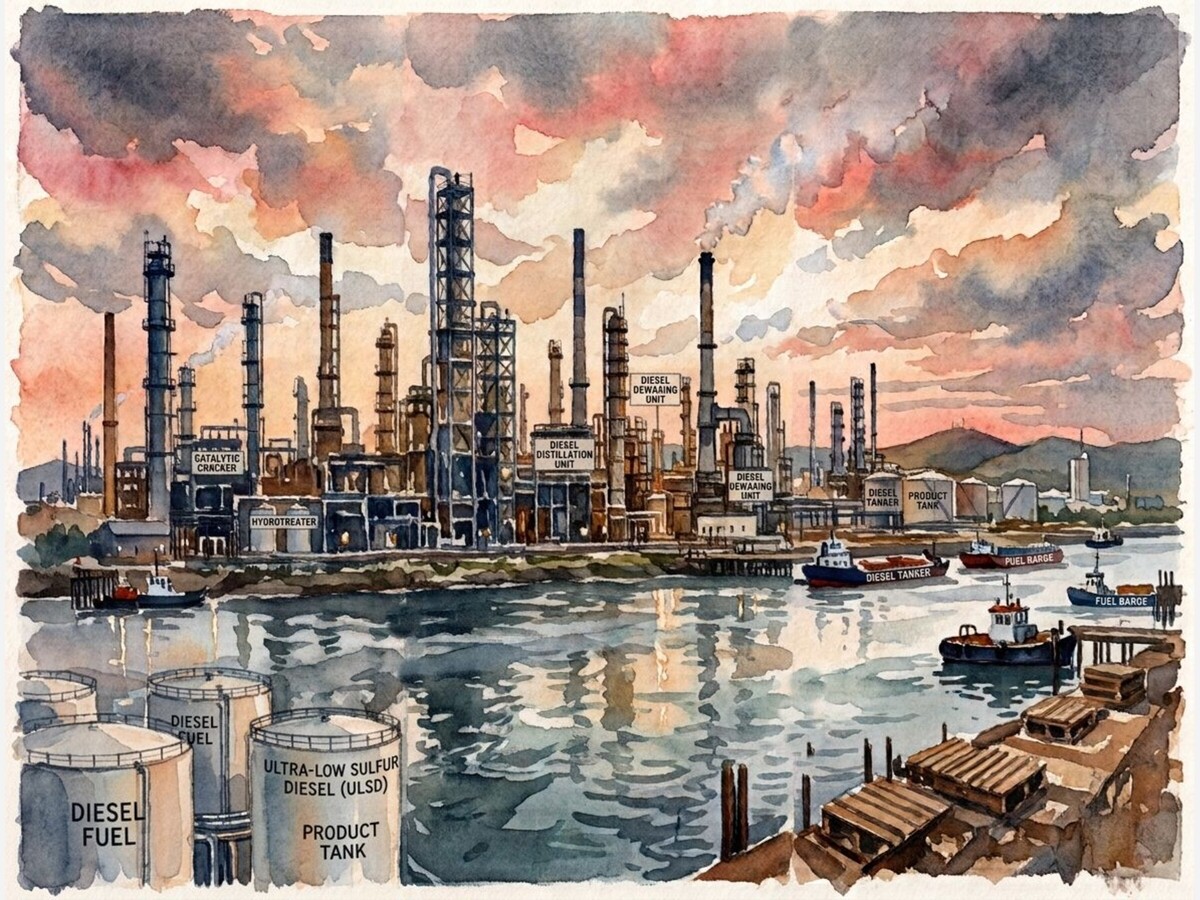
The instinct is to blame crude oil, since that is the villain we know. But crude is behaving itself. It closed a bit above eighty dollars a barrel this month, comfortably below its own spring highs. [2] The real story is downstream, in the plumbing nobody thinks about until it clogs. Refining diesel to modern low sulfur standards requires specific, expensive equipment, and the world simply does not have enough of it in the right places. China and the United States between them hold more than a third of global refining capacity. Europe has been quietly closing refineries for two decades and now imports much of what it burns. [3] When war knocks out capacity in the Gulf and Russia at the same time, there is no spare valve to open. Diesel does not care about your feelings, or your ceasefire.
Here is the twist that makes for good dinner conversation. America is not short of diesel. It is, if anything, embarrassingly flush with it, and the reason the shortage still bites at home is that the rest of the world wants what we are making. In one recent week, American refiners exported nearly two million barrels a day of distillate while importing almost nothing, the largest such gap on record. [4] The United States is not the victim of this shortage so much as its most successful exporter, which is a strange thing to be victimized by. Every gallon that leaves the Gulf Coast for Rotterdam or Santiago is a gallon a Nebraska farmer bids against, and price is how the world settles the argument.
Somebody is having a very good year, and it is not the farmer. Marathon Petroleum, Valero, and Phillips 66 posted combined quarterly profits of twelve and a half billion dollars, their best stretch since the last time Russia set the oil market on fire, and they promptly returned most of it to shareholders through buybacks. [5] Their stock prices have very nearly doubled. One imagines the champagne budget at these companies has also doubled, though nobody discloses that line item. It is worth saying plainly that this is not villainy, just arithmetic. Refiners buy crude and sell diesel, and when the gap between those two prices widens to historic proportions, they are contractually obligated by the laws of capitalism to notice.
The uncomfortable part is that record profits are supposed to summon record investment, and this is the one place the system is not working as advertised. Refining capacity behaves less like a crop and more like a glacier. It took decades of accumulated capital to build, and once the ice retreats, cold weather does not bring it back. The refineries that closed in 2020 and 2021, when demand collapsed and every board of directors was busy explaining its decarbonization strategy to nervous shareholders, are not reopening because the crack spread had one spectacular summer. Rebuilding that capacity requires the kind of twenty or thirty year capital commitment that nobody wants to make into an energy transition that is, at least officially, trying to make diesel obsolete. [6] The very policy signal that justified closing the old refineries is the same signal now discouraging anyone from building new ones, which is either a paradox or a punchline depending on your mood.
None of this stays politely contained to a barrel of crude. Diesel underwrites the entire physical economy, from the tractor to the truck to the supermarket shelf, and the toll it takes shows up on your receipt with a delay, not a debit card swipe. The path runs from the pump to the freight contract, a lag of a week for truckers and up to two months for rail, and then a few more weeks before it reaches the shelf. [7] Once it lands on the price tag, it appears in the government’s inflation reports almost immediately, since the Bureau of Labor Statistics is simply out there every month writing down what things actually cost. The real delay was never in Washington’s paperwork. It was already baked into the freight contracts, quietly working its way toward your grocery cart while everyone was still arguing about the Middle East. [8]
Which brings us to the part of the story with the most interesting cast of characters. The Federal Reserve, under its new chairman, was installed this year on the explicit promise of lower rates, and has instead spent the summer doing the opposite of what it was hired to do, holding steady while three of its own members publicly voted for a hike. [9] The president who wanted rate cuts now finds himself praising a Fed chair he privately suspects of wanting the same cuts but being outvoted by his own board, which is either an elegant piece of political jiu jitsu or a man watching his own appointment slip the leash, and reasonable people can disagree about which. Meanwhile, the November midterms sit on the calendar like an unspoken guest at the table, and nobody in Washington needs a chart to explain why an administration might prefer the Fed stay quiet until the votes are counted. [10]
History offers a cautionary tale here, and it is a good one. In 1972, Fed Chairman Arthur Burns kept interest rates accommodating through Richard Nixon’s re-election campaign, a decision that still divides historians between those who call it independent judgment and those who call it a favor, and that ambiguity is itself the lesson. [11] The inflation that followed took most of a decade and a brutal recession to wring back out of the economy. Nobody is suggesting we are there yet. But the machinery of that mistake, a central bank timing its patience to an election rather than to its own data, is not a relic. It is a lever that still exists, and someone is always tempted to pull it.
If the Fed does hold rates artificially low while inflation keeps climbing, the bill does not vanish, it just changes currency. Real interest rates, the return on your money after inflation eats its share, go negative, and investors respond exactly as their grandparents did, by buying gold. Gold has already touched five thousand dollars an ounce this year and several major banks think it has more room to run if the Fed keeps its hands in its pockets. [12] A softer dollar, the natural companion to lower real rates, makes oil more expensive for the rest of the planet and gold more attractive to everyone holding a currency that is not the dollar, which is its own quiet feedback loop running in the background of this whole affair. [13] It is worth remembering that gold does not pay rent to a struggling household. It pays rent to whoever already owned some, which is a tidy summary of who wins when a government chooses to manage inflation psychologically instead of monetarily.
A few myths deserve a quiet burial before they get repeated at a dinner party near you. Releasing the Strategic Petroleum Reserve will not fix any of this, since the Reserve holds crude oil, not diesel, and the bottleneck was never about crude. [14] And this is not primarily a story about villains, despite how satisfying that framing is. It is a story about a system that spent five years optimizing for a future that has not arrived yet, got caught by a war it did not schedule, and is now discovering that the fastest way to lose refining capacity is a bad quarter, while the slowest way to rebuild it is almost everything else.
The glacier will grow back eventually. Glaciers always do, given enough cold winters and enough patience from people who are not currently paying eight dollars a gallon in the San Joaquin Valley. In the meantime, the smart money has already worked out where to put its coat, and it is not in the checking account.
Sources
[1] 24/7 Wall St, “Diesel Crack Just Broke $100 a Barrel for the First Time Ever,” August 18, 2026; Bloomberg, “Diesel Margins Top $100 a Barrel to Reach Record High,” August 18, 2026
[2] Bloomberg, ibid.; 24/7 Wall St, ibid.
[3] statbase.org, “Oil refining capacity. Data by Countries from 1965 to 2025”; Rystad Energy, “Fewer refineries, greater capacity: Middle East and Asia lead the charge,” May 20, 2026
[4] Ag Bull Trading, “Diesel Exports Hit a Record as U.S. Distillate Stocks Sink Further Below Normal,” August 2026; Bloomberg, “US Diesel Exports Hit Record as Global Shortage Draws Down US Stockpiles,” August 5, 2026
[5] Reuters via 93.3 The Drive / peoplenewstoday.com, “Top US refiners see profits soar, step up investor rewards,” August 12, 2026; Investing.com, “4 Refining Stocks Riding a Historic Windfall,” August 2026
[6] discoveryalert.com.au, “Saudi Aramco’s Oil Refining Underinvestment and the Global Fuel Crisis,” June 3, 2026; discoveryalert.com.au, “Global Refining Capacity Shortage: What’s Driving the 2026 Crisis”
[7] Transportation Energy Institute, “The Economy Runs on Trucks, and Trucks Run on Diesel,” June 30, 2026; Alabama Gazette, “Where fuel costs are climbing fastest, and why shelf prices are next,” April 30, 2026
[8] U.S. Bureau of Labor Statistics, “How to Use the Consumer Price Index for Escalation”; BLS, “Consumer Price Index Frequently Asked Questions”
[9] U.S. Bank, “Federal Reserve Holds Rates at 3.50%-3.75% in July 2026”; The American Prospect, “Trump’s New Fed Chair Deserts Trump,” July 29, 2026
[10] CNBC, “Fed meeting recap: Warsh says Fed won’t hesitate to stop inflation,” July 29, 2026; Yahoo Finance / Politico, “Fed on collision path with Trump as rate hikes loom on horizon”
[11] Abrams, Burton A., “How Richard Nixon Pressured Arthur Burns: Evidence from the Nixon Tapes,” Journal of Economic Perspectives, 2006; Democracy Journal, “Rethinking Arthur Burns, the ‘Worst’ Fed Chair in History,” March 13, 2023
[12] MintBuilder, “Gold Price Forecast 2026”; Intellectia, “Gold Price Rally August 2026”
[13] Bloomberg, “ING Says Dollar May Drop If Fed Holds Rates, Oil Prices Fall,” July 29, 2026; Cambridge Currencies, “USD Forecast 2026”
[14] discoveryalert.com.au, “Critical Warning Signs Facing the Global Oil Refining Industry in 2026”



Sunny, with a high of 61 and low of 44 degrees. Mist in the morning, sunny for the afternoon, clear during the evening, mist overnight.

This is really well done and should be read by everyone who will vote on the property tax levy lid increase in our upcoming election. I hope every LFP council member has already read it and understands it.
I'm impressed with the analysis but I didn't see any attribution so am curious to know whether this was written by a human or generated by AI.

Both.