69° and Cloudy
Image



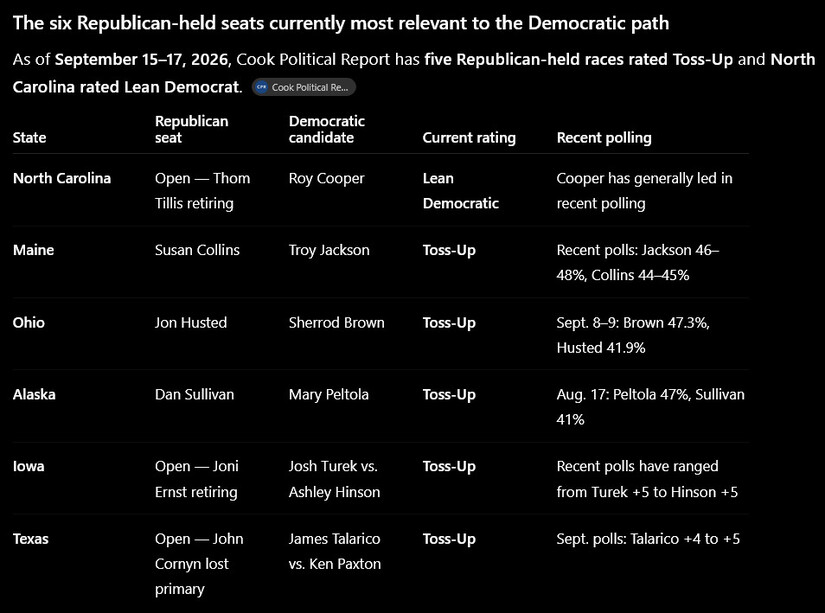
As of September 15–17, 2026, Cook Political Report rates five Republican-held races as Toss-Up and North Carolina as Lean Democrat.
With Republicans holding a 53-47 majority in the U.S. Senate, Democrats would need a net gain of four seats to take control of the chamber in November. That means the party must win at least four Republican-held seats while holding its own vulnerable seats.
Several Republican-held races have emerged as the principal battlegrounds, including contests in North Carolina, Maine, Ohio, Alaska, Iowa and Texas. Analysts differ on the competitiveness of individual races, but all six are receiving significant attention and campaign spending.
North Carolina is one of the most closely watched races on the map.
Former Democratic Gov. Roy Cooper is challenging Republican Michael Whatley, a former chairman of the Republican National Committee. The seat became open after Republican Sen. Thom Tillis decided not to seek reelection.
Cooper has won statewide elections before, while Whatley has not previously held elected office. Cook Political Report and the University of Virginia's Center for Politics currently characterize the contest as Lean Democratic.
The race is particularly significant because North Carolina has generally remained competitive in statewide elections despite its recent Republican presidential voting pattern.
Republican Sen. Susan Collins, who has represented Maine since 1997, is seeking another term against Democrat Troy Jackson, a former president of the Maine Senate.
Collins has developed a reputation for occasionally breaking with her party and has won reelection in Maine even during difficult political environments for Republicans. Jackson is emphasizing his background as a logger and his record in the state legislature.
Cook Political Report and the University of Virginia's Center for Politics currently consider the race a toss-up.
The Democratic nomination changed significantly during the summer after candidate Graham Platner withdrew from the race. Jackson subsequently became the Democratic nominee.
Ohio presents another highly competitive contest.
Republican Sen. Jon Husted, who was appointed to the Senate after JD Vance became vice president, is seeking election to a full term. His Democratic opponent is Sherrod Brown, who represented Ohio in the Senate from 2007 through 2025 before losing reelection in 2024.
Brown is attempting a political comeback in a state that has moved considerably toward Republicans in recent presidential elections.
Cook Political Report and the University of Virginia's Center for Politics currently rate the race as a toss-up.
The campaign has also attracted substantial outside spending. Recent reporting has identified economic concerns, including energy costs and employment, as issues both campaigns have emphasized.
Alaska has an unusual twist this year: two candidates named Dan Sullivan are on the general-election ballot.
Republican Sen. Dan Sullivan is seeking reelection against former Democratic Rep. Mary Peltola and two other candidates. Alaska uses ranked-choice voting for the general election.
Peltola previously served in the U.S. House and became the first Alaska Native elected to Congress. She lost her House reelection bid in 2024 but remained competitive in a state that President Trump carried by a substantial margin.
The presence of another candidate named Dan Sullivan has added an unusual element to the race. Cook Political Report and the University of Virginia's Center for Politics currently classify the contest as a toss-up.
Iowa is another Republican-held seat that has become unexpectedly competitive.
Republican Rep. Ashley Hinson and Democratic state Rep. Josh Turek are competing for the seat being vacated by Republican Sen. Joni Ernst.
Hinson has Trump's endorsement and has emphasized healthcare, veterans' issues and government accountability. Turek, a former Paralympic wheelchair basketball player, has emphasized his record representing a conservative-leaning legislative district.
Iowa has not elected a Democrat to the Senate since 2008, and Trump carried the state by 13 percentage points in 2024. Nevertheless, Cook Political Report currently rates the race a toss-up, while the University of Virginia's Center for Politics rates it Leans Republican.
Perhaps the most closely watched Republican stronghold on the list is Texas.
Republican Ken Paxton, the former Texas attorney general, is facing Democratic state Rep. James Talarico.
Texas has not elected a Democrat to the U.S. Senate since 1988, and Trump carried the state by double digits in 2024. Yet the contest has attracted national attention because of Talarico's fundraising and polling showing a competitive race.
Recent polling has produced a relatively close contest, and Cook Political Report has classified the race as a toss-up.
Outside groups are also spending heavily. Reuters reported this month that Republican-aligned groups, including organizations associated with Trump and Elon Musk, have committed millions of dollars to the Texas contest.
The six Republican-held races represent the principal opportunities for Democrats to gain Senate seats:
North Carolina
Maine
Ohio
Alaska
Iowa
Texas
Democrats need a net gain of four to reach a 51-seat majority, assuming they retain their existing seats. That doesn't mean any particular four states are predetermined; a Democratic majority could result from different combinations of victories.
At the same time, Democrats must defend competitive seats of their own, particularly in Michigan, Georgia and New Hampshire. CBS News identifies those contests, along with the six Republican-held races above, among the key races that could determine Senate control.
The result is a Senate map in which a relatively small number of states could determine which party controls the chamber for the final two years of President Trump's term.
The six Republican-held battlegrounds aren't the only Senate races worth watching, but they offer the clearest path for Democrats to gain the four seats needed for a majority.


Overcast, with a high of 72 and low of 49 degrees. Mist for the morning, overcast for the afternoon, mist overnight.




This is really well done and should be read by everyone who will vote on the property tax levy lid increase in our upcoming election. I hope every LFP council member has already read it and understands it.
I'm impressed with the analysis but I didn't see any attribution so am curious to know whether this was written by a human or generated by AI.
Both.