


Image
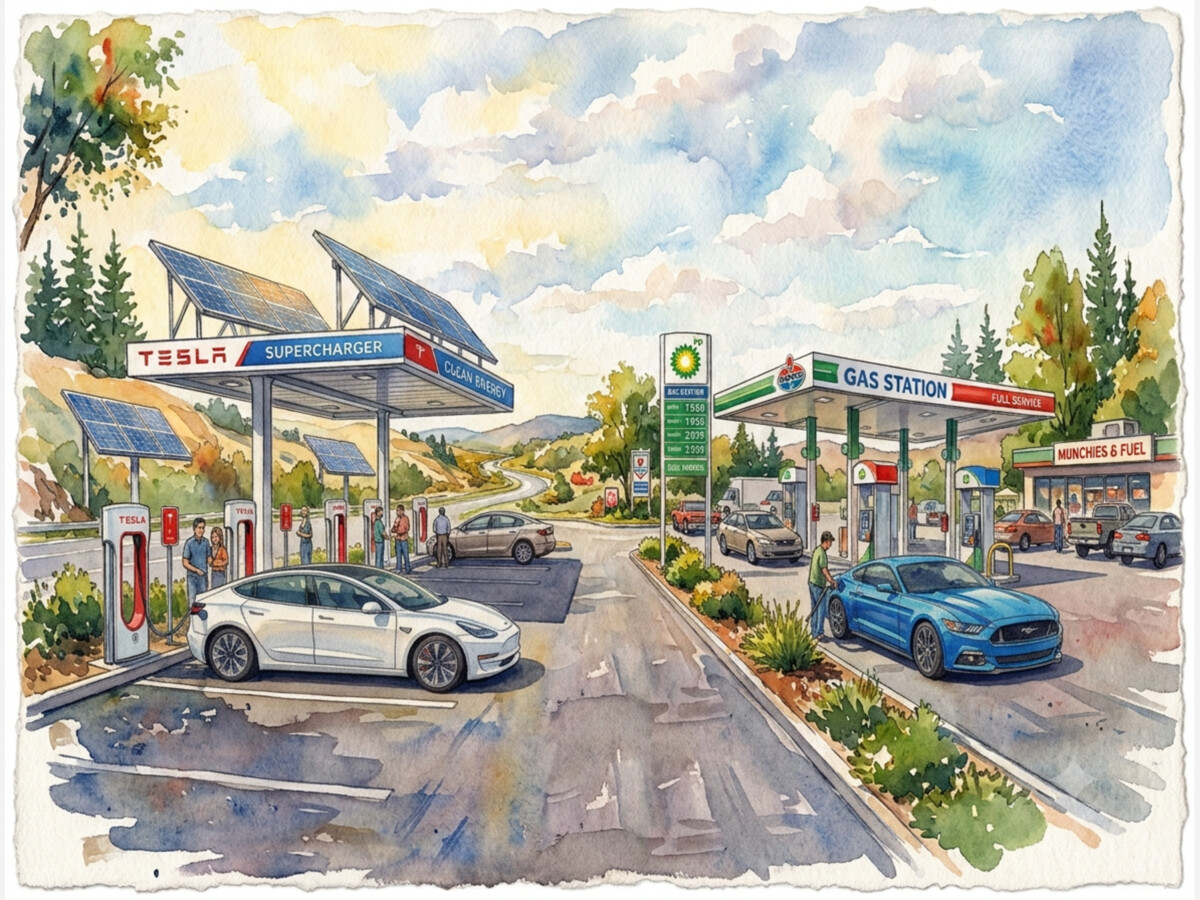
Opinion | Iko Knyphausen | July 15th, 2026
Every electric vehicle starts its life owing a carbon debt nobody mentions at the dealership, the footprint of making its battery, one that depends on where the battery cells were made and which chemistry they operate under. The base Tesla Model 3 sold in America uses a lithium iron phosphate battery. It does not contain any cobalt. Why does it matter? Roughly seventy percent of the world’s cobalt comes from the Democratic Republic of Congo, where the U.S. Department of Labor has documented tens of thousands of children working in the mines and forced labor conditions affecting a majority of workers there.1 Offering a model whose battery chemistry excludes that metal is not necessarily a promise about ethical sourcing. The pricier Model 3 trims, for example, use nickel and cobalt for extra range. A useful reminder that “EV” is not one product with one supply chain. The chemistry inside the pack matters as much as the badge on the trunk.
So the EV arrives already in debt, and whether buying one was a good idea, environmentally speaking, depends on how fast it pays that debt off, and what the full ledger looks like once it does. How efficiently does the car turn electricity into miles? How dirty was that electricity to begin with? For this article, we compare a basic Tesla Model 3 against a gas-powered Ford Mustang, the EcoBoost four-cylinder rated at 26 miles per gallon. We compare them across three markets: Washington State, which runs on hydropower and nuclear energy and produces the cleanest electricity in the country; the national average; and West Virginia, the most coal-dependent grid in the nation.2 3
We measure 2 breakevens, one that occurs the moment (mileage) the Tesla leaves a smaller CO2 footprint, and one that occurs once the Total Cost of Ownership is lower than that of the Mustang.
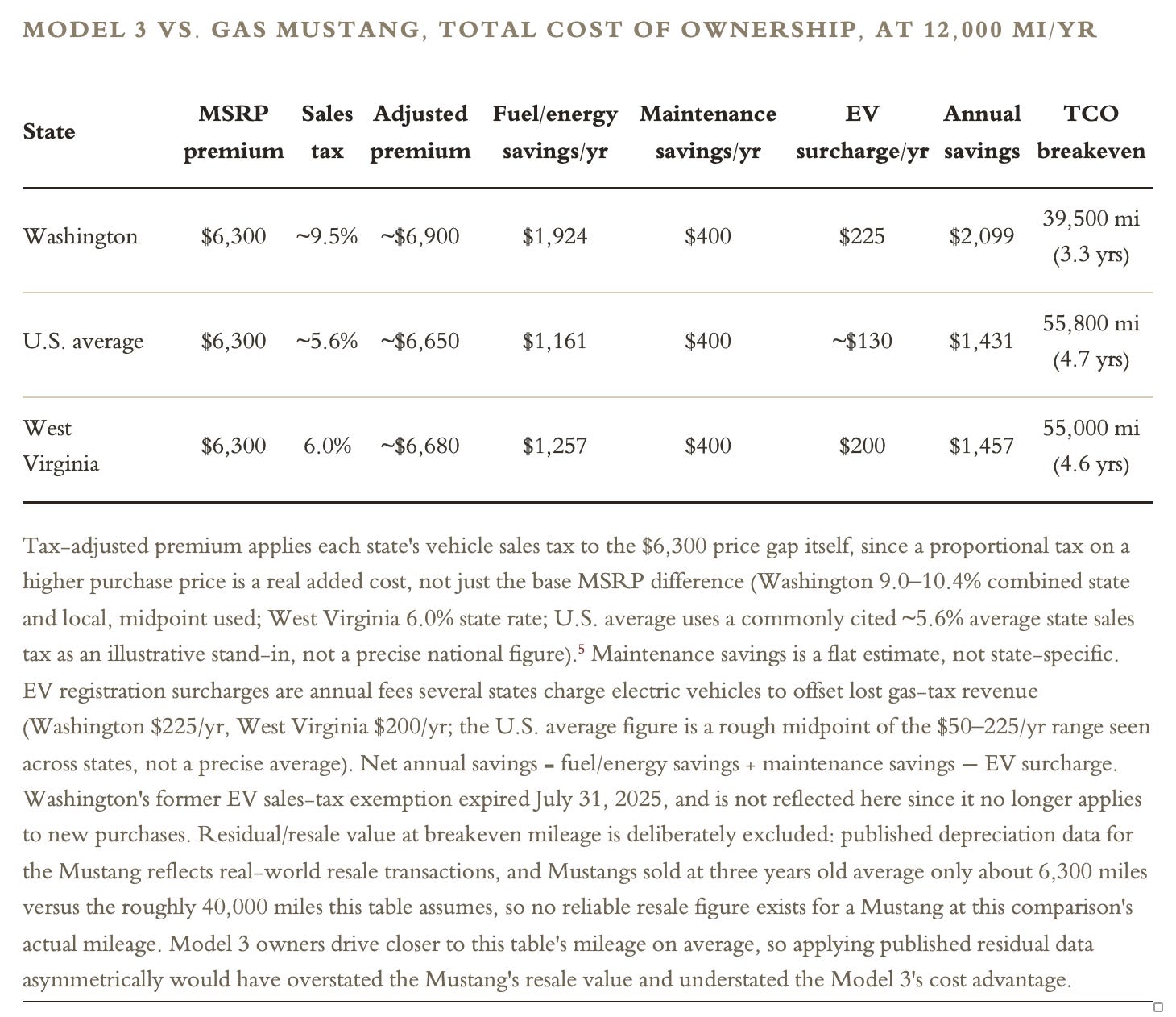
The cost of gasoline in Washington is high; the cost of electricity is low. Both of these circumstances favor the use of EVs. West Virginia’s gas prices are lower than in Washington, and even lower than the national average, but although its electricity is almost as affordable as in Washington, it carries a hefty CO2 footprint. West Virginia burns coal to make power. Low gas prices and dirty electricity weigh on the EV proposition. The nationwide average for residential electricity service, as reported by the U.S. Energy Information Administration, is about 18 cents/kWh — mostly driven by high rates in CA and the Northeastern states. This average rate is 4-6 cents greater than those reported for each WA and WV, and the least favorable when computing the energy cost of operating EVs.5
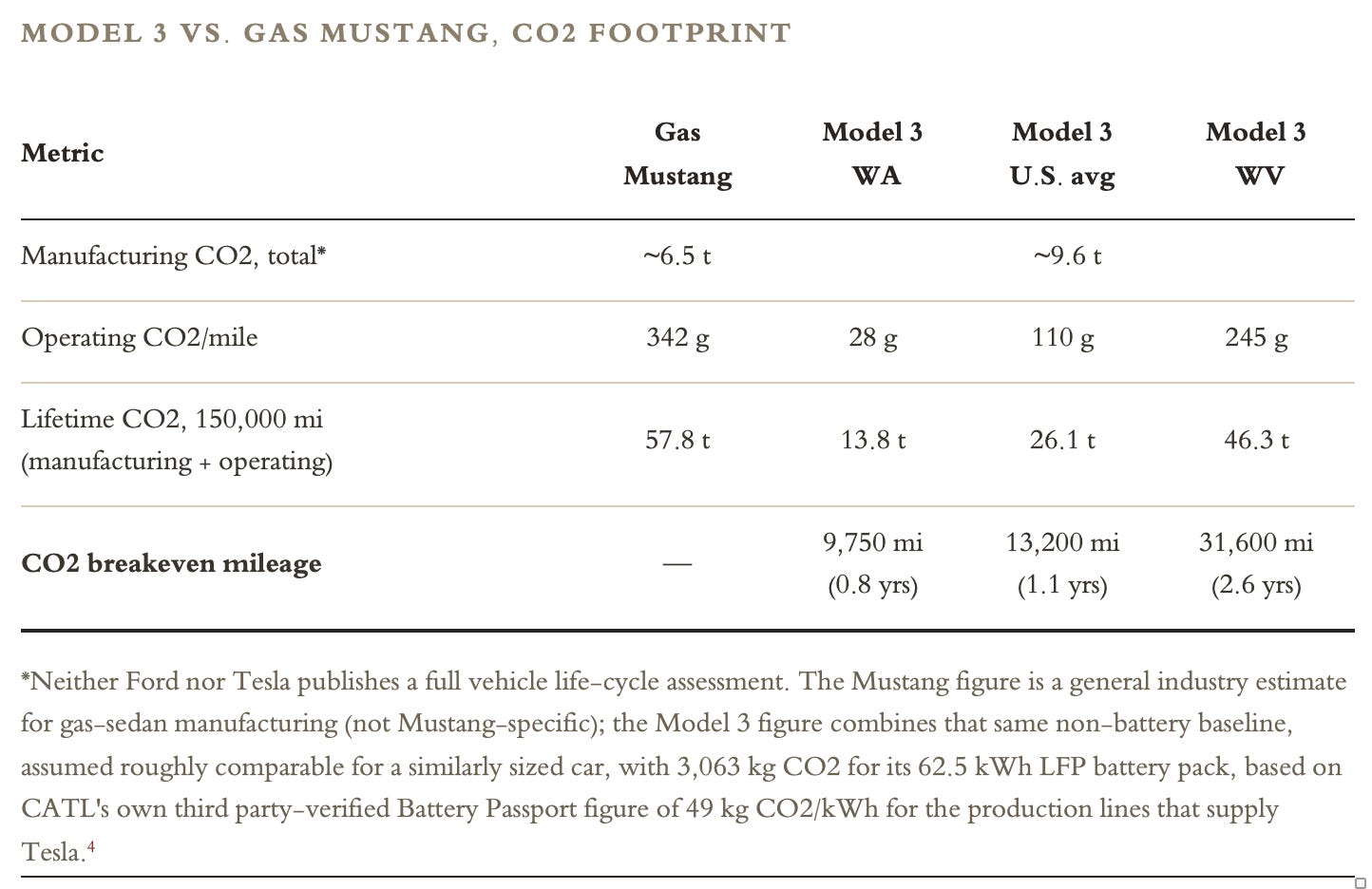
The Model 3 beats the Mustang on every measure, in every grid, including the single dirtiest one in the country, on both the breakeven date and the lifetime total. That is worth sitting with, because it is not the answer most people expect, and it is not automatically true of every EV. It holds here because the Model 3 is efficient enough, at nearly four miles per kilowatt-hour, that even carbon-heavy electricity produces less pollution per mile than gasoline combustion does. A heavier, less efficient electric vehicle would not necessarily clear that bar on West Virginia’s grid. The lesson is not “EVs are always greener.” It is that an EV’s environmental case rides on its own efficiency as much as on the grid behind it, the car keeps getting cleaner as the grid itself decarbonizes further, and the two variables multiply together rather than standing in for one another.
Comparing the Model 3 to a Mustang EcoBoost may seem like comparing apples to oranges. For example, I could have used the legendary Ford F-150 and its EV sibling, the F-150 Lightning. The same chassis and purpose for a truck, and I did indeed consider them; however, the F150 lighting was only produced between April 2022 and December 2025, with a total production of roughly 100,000. The gasoline-powered truck has sold more than 43 million. The Lightning fell victim to the rescinding of the 7,500 tax credit, and its discontinuation made the comparison mute. A similar story for the Hyundai Kona and its EV sibling. Even though the Ford Mustang Mach-E is still running, it’s not galloping. After the tax credit ran out, it only sold 11,000 units in the first half of 2026, down from 51,000 in 2025.
Long story short, the gas-powered Mustang has sold 10 million units since Iacocca introduced it in 1964, one year after yours truly was born. The 185,000 units of the Mach E sold did not seem like a good candidate for an EV representation. The Tesla Model 3 mirrors the sporty driving dynamics of a Mustang, has sold 3 million units, and isn’t going away soon. It speaks to a comparable clientele, lives in a similar price segment, and can be found on the roads everywhere.
On the financial front, amortization follows the exact same reasoning as with the energy savings, but develops much slower: a purchaser will recover the cost difference for the Model 3 in less than 5 years, depending on where he/she lives; however, the breakeven time for the environmental benefits varies greatly by location and will be much sooner — within one year — in Washington, versus approximately 2.5 years in West Virginia. Another interesting point regarding the residential electricity rates we have used in this comparison is that in most of the US, Time-of-Use (TOU) pricing is available, with significantly reduced rates during off-peak hours. As an example, in Seattle, the rate of 12 cents/kWh can decrease to 8 cents/kWh when charging a Tesla from midnight until 6:00 AM -- a 33 percent reduction, reinforcing the financial benefit of electric vehicles.
That waiting period until you reach break-even is exactly where the federal tax credit did its work, and the last year of sales data makes the case more honestly than any advocacy pamphlet could. When the $7,500 federal EV credit expired in September 2025, the entire U.S. EV market’s share of new vehicle sales fell to 5.7 percent in the fourth quarter, down sharply from where it had been running.6 That collapse is evidence that the credit was moving real purchases, not manufacturing demand that would have existed anyway. A fair-minded piece should say so plainly rather than dodge it. But that concession does not settle the policy question, because the question is not whether the credit worked. It is whether the government should subsidize, promote, and accelerate the transition, instead of letting the markets do it at their own pace?
Here is the honest version of that argument. It is not that the government has shown more patience than private capital in this market; the credit’s own history undercuts that claim. It was created in 2009, then structured with a 200,000-vehicle-per-manufacturer cap that penalized exactly the companies succeeding fastest, costing Tesla and GM their eligibility around 2019 as a reward for winning. The Inflation Reduction Act fixed that flaw in 2022. The 2025 tax legislation eliminated the credit entirely three years later.7 That is not a government demonstrating unusual long-term thinking. That is a policy tool that has been restructured or withdrawn three times in sixteen years, tracking changes in political control rather than any assessment of whether the underlying technology had matured. The real claim, the one this history actually supports, is narrower and more useful: government is the only actor structurally capable of financing a payoff horizon this long, if the political will exists and the policy is built to survive a change in Congress. The last three years are evidence that capability has not yet been matched by durable design, which is the policy failure worth writing about, not proof that subsidies themselves were the wrong idea.
There is a bigger reason to care about getting that design right, one that goes beyond any single buyer’s four-year payback period. A fleet of American EVs is not just transportation; it is distributed energy storage that also gets people to work. GM alone reports more than 250,000 bidirectional-capable vehicles already on American roads, vehicles that, aggregated, could theoretically power around 120,000 homes for a week.8 The International Energy Agency’s own technology assessment found vehicle-to-grid charging offers the largest hourly energy flexibility of any grid technology it evaluated, a notable finding from an agency not prone to hype.9 Here is the proof of the pudding: Texas utilities logged 180 grid-service dispatch events from EVs in 2024. Maryland adopted the nation’s first comprehensive vehicle-to-grid interconnection rules in 2025. A Colorado school district earned $12,000 in a single quarter by selling power back to the grid from its electric bus fleet.10 One projection holds that if just five percent of American EVs were grid-enabled by 2030, they could deliver 600 gigawatts of peak-demand support nationally, a genuinely systemic figure.
Unlocking this capacity is not without near-term friction: bidirectional home chargers remain a costly aftermarket installation, and automotive manufacturers have yet to standardize warranty structures to protect owners who cycle their batteries for the grid. The batteries do wear slightly faster under this kind of cycling, roughly nine to fourteen percent more degradation over ten years by one careful study’s estimate, but that friction and cost is modest next to what the aggregate asset is worth: solar and wind power that is generated only when the sun shines and the wind blows, buffered by millions of batteries that are, for most of the day, sitting idle in driveways anyway.11 Subsidizing the vehicle purchase is, in this light, not really a car subsidy. It is an investment in dual-use infrastructure that happens to also be a car, and infrastructure with a payoff measured in decades is precisely the kind of bet private markets are structurally bad at making alone.
The technology underneath all of this is also still evolving, and it’s moving in a way that directly addresses the mining critique rather than asking anyone to simply trust that it will improve someday. Sodium-ion batteries, sometimes called salt batteries because they draw their active ingredient from the same abundant mineral family as table salt, reached cost parity with lithium iron phosphate cells in early 2026 and now run thirty-five to forty percent cheaper. They use no lithium, no cobalt, and no nickel at all, replacing copper current collectors with aluminum for further savings.12 The “pudding” has left the laboratory. CATL’s sodium-ion line entered mass production in 2025 and 2026, and the first mass-production sodium-ion passenger car, a joint effort between CATL and the Chinese automaker Changan, reached the market in 2026.13 The tradeoff is energy density: sodium cells still trail premium lithium chemistries badly enough that they suit budget and urban vehicles rather than long-range cars like the Model 3, and industry forecasts expect them to capture perhaps eight to twelve percent of total battery capacity by 2030, not to replace lithium at the top end.14 But for the segment they do serve, they make the DRC cobalt mines and the water-hungry lithium brine operations of the Atacama irrelevant by design. That is the trajectory worth watching: not a single silver-bullet battery, but a chemistry landscape splitting into tiers, expensive long-range cars still drawing on a supply chain that deserves scrutiny, and a growing tier of cheaper, shorter-range vehicles and grid batteries that increasingly do not.
So: how green is an EV? It depends, genuinely and measurably, on the car and on the grid, and this pairing shows what happens when the car is good enough that the grid mostly stops mattering. It also depends on a policy question nobody has yet answered: whether the country is willing to build a subsidy durable enough to survive an election in exchange for a fleet of batteries that could end up doing more for the grid than for any single driveway. The Model 3 clears its own carbon debt even when charging on coal power; it just takes longer there than anywhere else. The harder debt, the one about whether American energy policy can commit to anything longer than a single term in office, is still outstanding.
Iko can be reached at iko@uw.edu
Notes



Overcast, with a high of 54 and low of 39 degrees. Overcast in the morning, cloudy overnight.




This is really well done and should be read by everyone who will vote on the property tax levy lid increase in our upcoming election. I hope every LFP council member has already read it and understands it.
I'm impressed with the analysis but I didn't see any attribution so am curious to know whether this was written by a human or generated by AI.

Both.