Image




As the world scrambles to combat climate change and conserve dwindling water supplies, a hidden environmental threat is expanding right at our fingertips. Every online query powered by Artificial Intelligence (AI) deepens our ecological footprint, as it is driven by a massive network of resource-intensive data centers.
Worse yet, tech giants remain largely silent about the exact toll their systems take on the planet.
"AI is going in the opposite direction to decarbonization efforts. If you’re recycling and a vegan but then you’re using ChatGPT to do your multiplication for you, well that’s kind of against the trend."
— Sasha Luccioni, Cognitive Computer Scientist & Chief Scientific Officer, Sustainable AI Group
While tech companies are increasingly forcing generative AI into everyday tools, several sustainability, water, and computing experts outline how everyday consumers can reclaim control and reduce their digital footprint.
According to a report from the United Nations University, global data centers consumed 448 trillion watt-hours of electricity last year—ranking their power use higher than all but 10 countries worldwide. That demand is projected to more than double in the next four years.
Kaveh Madani, a water scientist and director of the United Nations University Institute for Water, Environment and Health, co-authored the study and broke down the stark reality of AI consumption:
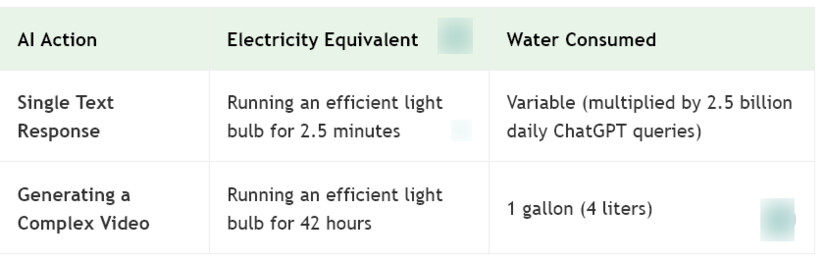
By 2030, the electricity needed to run these data centers—excluding the immense volumes of water used directly to cool the hardware—will indirectly require
The most effective solution is the simplest: use AI less. "The cleanest form of AI use is no use," notes Madani.
Experts advise bypassing AI for basic tasks that traditional search engines or physical mediums can easily handle, such as:
When you do use AI, keep your queries concise. Providing excessive background information or being overly polite forces the system to do more computing, wasting unnecessary energy and water.
Tech companies have initiated a "bait-and-switch," integrating AI into standard search engines without asking. However, users can actively opt-out using these methods:
-ai to the end of your search queries, or manually click the "Web" tab in search options to get traditional results.Big Tech responds to market pressure and local resistance. Ana Pinheiro Privette, a data scientist and former top sustainability official for Amazon Web Services, notes that tech corporations heavily monitor consumer sentiment. "They listen if everybody suddenly starts caring about not having a footprint," Privette says.
Furthermore, community backlash against data center placement is forcing structural changes. For context, data centers in just two Virginia counties consumed 2.1 billion gallons (8 billion liters) of water in 2023 alone.
Because data centers have become "the new boogeyman," according to Balaji Tammabattula, COO of infrastructure firm BaRupOn, developers are being forced to design more energy- and water-efficient campuses to appease local communities.
A major hurdle to solving this crisis is the severe lack of corporate transparency. Because private AI entities rarely disclose resource metrics, scientists must rely on estimates modeled from open-source AI.
Mosharaf Chowdhury, a computer science professor at the University of Michigan who tracks open-source energy metrics, warns that a lack of disclosure strips consumers of agency: "If there’s no transparency, we have no choice."
Privette echoes the need for systemic transparency, stating that true consumer power lies in demanding to know the environmental cost of the digital products we consume.
This article is based on reporting by Seth Borenstein for the Associated Press.



Overcast, with a high of 54 and low of 39 degrees. Overcast for the morning, cloudy overnight.





This is really well done and should be read by everyone who will vote on the property tax levy lid increase in our upcoming election. I hope every LFP council member has already read it and understands it.
I'm impressed with the analysis but I didn't see any attribution so am curious to know whether this was written by a human or generated by AI.
Both.