



Image
Opinion · June 5th, 2026 · Iko Knyphausen
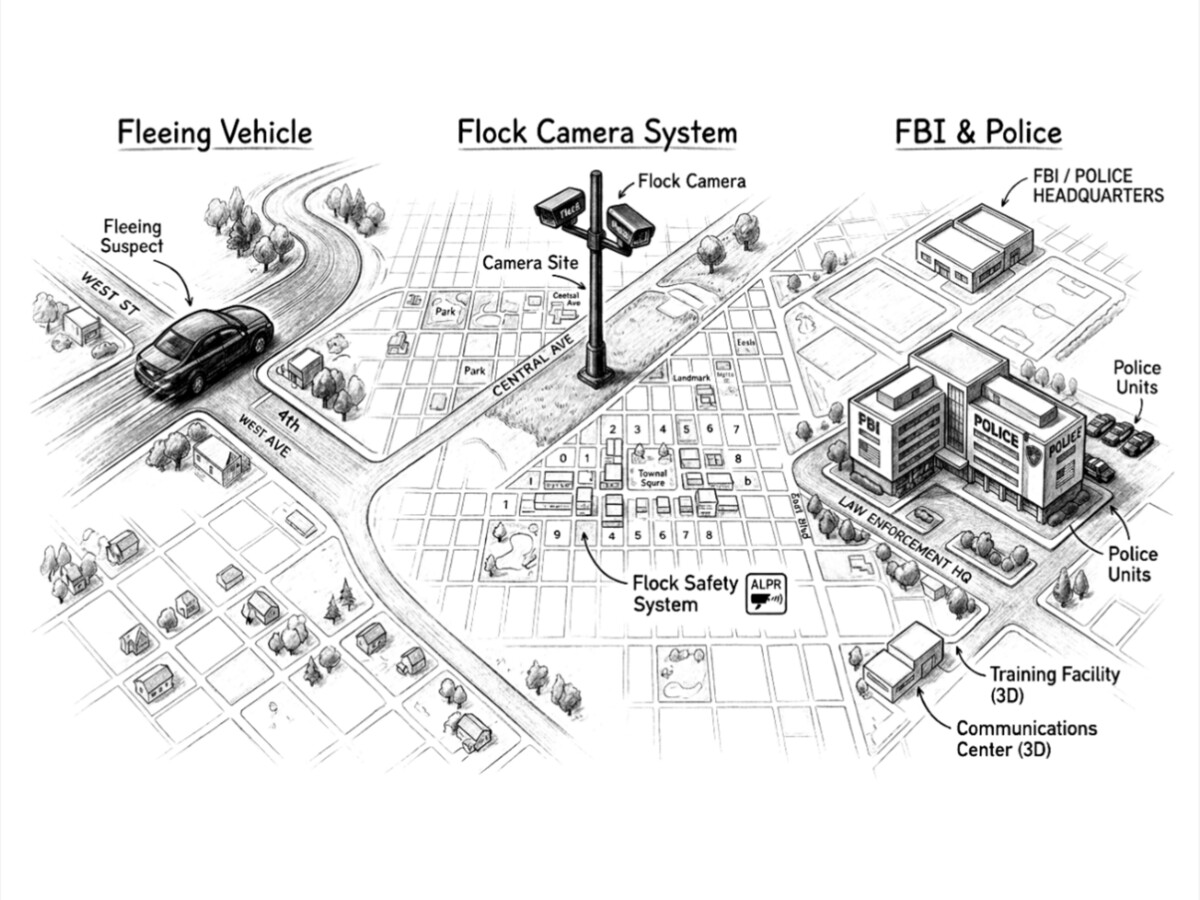
Consider two moments from recent American life. In Fond du Lac County, Wisconsin, a carjacking suspect is apprehended within hours after ALPR cameras capture the vehicle fleeing the scene. In Lenexa, Kansas, police use the same technology to track a man who wrote a critical opinion piece about their department. Both things happen. Both are legal. Neither requires a warrant.
One of those uses is what the technology was built for. The other is what happens when technology built for one purpose operates without rules governing any other.
Automated License Plate Readers, or ALPRs, are high-speed camera systems mounted on police cruisers, highway overpasses, traffic signals, and the entrance gates of private communities. They photograph every passing vehicle, extract the plate number, and compare it against law enforcement hot lists in milliseconds. A modern ALPR can process up to 1,800 plates per minute.1
The leading commercial provider in the United States is Flock Safety, serving more than 6,000 communities and claiming coverage of well over half the American population as of 2026.2 Those figures come from Flock’s own materials; independent verification is not publicly available. What is documented is that the system connects cameras across jurisdictions into a searchable national network. Motorola Solutions operates a competing network, and together these two vendors represent essentially the entire field of candidates for a new $36 million FBI contract seeking coverage of at least 75 percent of U.S. locations.3
It is worth distinguishing two types of ALPR infrastructure. Publicly owned systems, installed and operated by government agencies, are subject to public records laws and democratic oversight. Privately owned systems, including cameras installed by homeowners associations and commercial property owners linked into Flock’s network, are governed primarily by contract. When police query the latter, they access data collected by private parties, a distinction with significant legal implications courts have not yet fully resolved.
Today’s systems capture more than plate numbers. They record vehicle color, make, model, and distinguishing physical features such as damaged body panels or aftermarket accessories, creating a vehicle profile that persists even if the license plate is changed, because the physical description is stored independently of the plate number field.4 The privacy implication is that changing your plates does not reset your surveillance record.
The evidence that ALPRs produce real public safety outcomes is substantial, even if some of the numbers come with interpretive caveats.
San Francisco’s crime collapse. San Francisco deployed 400 Flock ALPR cameras and a drone program under a voter-approved Proposition E in 2024. Overall crime fell from 49,234 incidents in 2023 to 28,567 in 2025, a reduction of 42 percent over two years. Auto break-ins fell 54 percent, motor vehicle theft dropped 24 percent, and violent crime fell 45 percent. By year’s end, homicides reached a 70-year low, with only 28 recorded in 2025, the fewest since 1954.5 The SFPD’s Real-Time Investigation Center, fusing Flock ALPR data with drone feeds and public safety cameras, assisted in more than 500 arrests, including 207 specifically attributed to ALPR hits. In one case, an ALPR alert identified a stolen vehicle in the South of Market neighborhood; officers deployed a tire-deflation device and arrested two occupants.6 San Francisco is not a controlled experiment, and these reductions cannot be attributed to ALPR alone. But the scale and speed of the decline make the technology difficult to dismiss.
Interstate crime rings. A multi-jurisdictional burglary crew operating from Florida into Wisconsin illustrates why networked ALPR matters. Investigators identified the crew’s vehicle through Flock camera data after a series of home burglaries, tracked its return to Florida, and when the suspects traveled north again in a different vehicle, combined cell carrier data with Flock images to make arrests across state lines.7 No single jurisdiction’s cameras would have been sufficient. The network was the case.
Missing persons and AMBER Alerts. Flock reports returning more than 10,000 missing persons in a recent year, roughly one per hour, through its AMBER Alert integration with the National Center for Missing and Exploited Children.2 Individual cases, including a one-year-old recovered after a stranger abduction, give those aggregate numbers human weight.8
Stolen vehicle recovery. In Los Altos, California, more than 4,500 database searches in 2025 correlated with a 41 percent decrease in residential burglaries over two years.9 Nationally, Flock’s own survey of 700 agencies reported that more than 40 percent credited the system with recovering at least half their stolen vehicles.10 These are vendor-sourced figures, but the directional evidence from independent police departments is consistent.
The most important thing a policy framework can do for ALPR is recognize that the technology serves two operationally distinct purposes that demand different governance rules. Conflating them produces policy that is either uselessly restrictive or dangerously permissive.
Mode One: Real-time hot list alerts. This is the primary and predominant use of Flock in the field. A camera reads a plate. The system compares it against active hot lists drawn from NCIC and state crime databases: stolen vehicles, AMBER Alerts, active warrants, BOLOs, domestic violence suspects, wanted persons. If there is a match, an officer receives an immediate alert on a mobile device, typically within seconds. The officer responds. The system integrates with FBI’s National Crime Information Center and state hotlists.11 This mode is functionally identical to an officer running a plate at a traffic stop, a practice courts have consistently held requires no warrant because the plate is in plain view on a public road. The speed and automation are different. The legal principle is the same.
A warrant requirement imposed on real-time hot list alerts would render the technology useless for its core purpose. An AMBER Alert does not pause while an officer seeks judicial authorization. A domestic violence suspect does not stop driving. A stolen car does not park and wait. The constitutional framework already accounts for this: the exigent circumstances doctrine and the plain-view doctrine together mean that a real-time ALPR alert generating a stop does not require prior judicial approval any more than a patrol officer who spots a stolen vehicle on the street does. Even the ACLU, which has been the technology’s most persistent critic, states that it does not object to using ALPRs to check plates against stolen vehicle lists or for AMBER Alerts, provided the system is deployed fairly and the hot lists are legitimate and current.12
What real-time alerts do require is accountability on the front end rather than judicial authorization in advance. Every query should require the officer to log a necessity statement: the reason for the search, the specific hot list or criteria used, and the incident or dispatch record to which the query is tied. That log creates the audit trail that enables oversight after the fact. A supervisor or independent reviewer can examine whether the system is being used for legitimate operational purposes or is drifting toward surveillance. The Orange County Sheriff’s Department’s published ALPR policy requires exactly this: written documentation of the purpose of any custom hot list, sergeant approval before posting, and verification of the alert before taking enforcement action.13 That is not bureaucratic excess. It is what distinguishes law enforcement from surveillance.
Mode Two: Historical database queries. This is a categorically different use of the same infrastructure. An investigator pulls up Flock’s database and searches for where a specific vehicle appeared over days, weeks, or months. This is not responding to a vehicle of interest that happened to pass a camera. It is constructing a retrospective account of a person’s movements, potentially across multiple jurisdictions, to develop evidence in a criminal case. San Jose’s ALPR system recorded more than 360 million images in 2024, and government employees searched the database nearly 2.5 million times in a single six-month period, an average of more than 13,000 queries per day, the vast majority with no established connection to any specific crime.14
This is the use that triggers the serious constitutional questions. The Supreme Court’s reasoning in Carpenter v. United States (2018) required a warrant for historical cell-site location records precisely because retrospective reconstruction of a person’s movements over time is qualitatively different from observing a single moment in public. The same logic applies to historical ALPR queries. The Brennan Center for Justice, in its policy framework for ALPR regulation, reached the same conclusion: except in emergency circumstances, historical ALPR searches should not be conducted without a warrant supported by probable cause.15 The Ninth Circuit in United States v. Yang acknowledged the genuine constitutional concern but declined to resolve it on the facts of that case.16 A Virginia trial court suppressed ALPR evidence obtained without a warrant; the EFF and ACLU urged the Virginia Court of Appeals to uphold that ruling.17
The warrant requirement for historical queries does not impede urgent investigations. Exigent circumstances exceptions already exist in Fourth Amendment doctrine and cover situations where waiting for judicial authorization would risk the safety of a victim, allow a suspect to flee, or result in the destruction of evidence. What it prevents is the routine warrantless use of a comprehensive movement database as a first-line investigative tool with no judicial oversight, no documented justification, and no check on mission creep. In the ALPR context, the most compelling exigency is not officer safety in the traditional sense but the safety of abduction victims and missing persons: every minute a child is missing is a minute that warrantless historical access to recent camera reads may matter. The framework accommodates that reality explicitly.
Since the beginning of 2025, at least 30 cities have canceled or suspended their Flock contracts, most citing unauthorized federal access and the absence of enforceable rules governing what the data can be used for.18 Austin, Texas allowed its contract to lapse in June 2025.19 Flagstaff, Arizona; Cambridge, Massachusetts; Eugene and Springfield, Oregon; and Santa Cruz, California all terminated contracts. Mountain View, California shut down its cameras after an audit revealed that the ATF, the Air Force, and the GSA Inspector General had accessed its surveillance data without authorization.20 Denver canceled after records revealed more than 1,400 immigration-related searches since 2024, including searches labeled “ICE,” and CBP had run approximately 200 searches during a pilot program the city had never been told about. In Cambridge, Flock was found to have installed unauthorized cameras. In Eugene, a camera was reactivated after the city ordered it off, discovered not by city staff but by a community member.
These cancellations are not evidence that ALPRs do not work. They are evidence that the public will withdraw consent when it cannot trust the rules. That is precisely the two-track governance failure: no accountability requirements on real-time alert use, and no warrant requirement on historical database queries. Both problems are solvable without dismantling the technology.
Immigration enforcement by the back door. ICE conducted more than 4,000 lookups in Flock’s network through informal arrangements with local police, sidestepping the contracting process that would have required public disclosure.21 An ATF analyst separately accessed Richmond’s Flock system to aid immigration enforcement, prompting the police chief to block all federal access.22 Senator Ron Wyden confirmed that Flock operated a pilot sharing data with DHS and ICE without notifying its municipal clients.23
Tracking political activity. EFF audit logs covering more than 12 million searches by 3,900 agencies documented hundreds tied to political demonstrations, including the February 2025 “50501” protests, April’s Hands Off marches, and the No Kings protests.24 In Lenexa, Kansas, police used ALPR data to track a man who wrote a critical op-ed about the department. The ACLU called it a “rare public example” of the abuse civil liberties organizations have long warned against.25
Reproductive healthcare surveillance. In Johnson County, Texas, a sheriff’s office ran an ALPR search tied to a woman who had undergone an abortion. A sworn detective affidavit confirmed it was part of a death investigation opened after a report about the abortion.26
Mission creep. Flock has announced plans to add video capability, allowing police to request live feeds and 15-second clips from any networked camera. EFF has documented agencies using Flock for traffic enforcement despite the company’s public assurances otherwise, and Flock has connected its feeds to commercial data brokers linking vehicle locations to personal identifying information.27
School cameras as immigration surveillance infrastructure. In a joint investigation published in February 2026 by The 74 and The Guardian, audit logs from Texas school districts revealed that more than 3,000 law enforcement agencies conducted more than 733,000 searches on the Alvin Independent School District’s Flock cameras in a single month, from December 2025 through early January 2026.28 Immigration-related reasons were cited 620 times by 30 agencies in states including Florida, Georgia, Indiana, and Tennessee. Civil immigration searches outnumbered criminal immigration searches roughly two to one. At Huffman Independent School District, a campus police chief’s assistant granted U.S. Border Patrol direct access to the district’s Flock cameras in May 2025. The cameras had been sold to the schools on a student safety pitch: active shooter response, sex offender alerts. They became a warrantless immigration surveillance network accessible to agencies in other states with no judicial oversight and no notice to the districts involved.
Washington State responded directly. Governor Bob Ferguson signed the Driver Privacy Act, Senate Bill 6002, into law on March 30, 2026, the first comprehensive statewide ALPR framework in the country.29 The law bans ALPR use for immigration enforcement, prohibits cameras on or near the premises of schools, places of worship, courthouses, and food banks, requires a warrant before law enforcement may obtain ALPR data from private entities, bans the buying and selling of ALPR data, mandates two-year audit trails for all data access, and makes willful violations a gross misdemeanor enforceable by private right of action. The ACLU of Washington, which supported the bill, noted it does not go far enough on data sharing between in-state agencies, but called it a meaningful first step.
None of these abuses involve stolen vehicle alerts or AMBER Alerts. Every one of them involves historical database queries or unauthorized data sharing: Mode Two uses, or uses that fall entirely outside either legitimate mode. The two-track framework would have prevented most of them. The necessity-statement requirement would have flagged the Lenexa political tracking. The warrant requirement would have blocked the Texas abortion investigation. The federal access prohibition would have stopped the ICE and ATF queries.
On May 14, 2026, the FBI’s Directorate of Intelligence published a Request for Proposals seeking up to $36 million for nationwide ALPR access with data returned in “near real time.”30 The contract requires coverage of at least 75 percent of U.S. locations, integration of red-light cameras, speed cameras, and repossession vendor feeds, and the ability to query by plate, partial plate, vehicle description, time, date, and geolocation.31
Whether the FBI intends to use this capability for real-time hot list alerts, historical investigative queries, or both, the same two-track rules must apply. Real-time alert use requires necessity logging and supervisory review. Historical database queries require a warrant or a documented exigency declaration. The bureau would have neither requirement under the current proposal. It would simply log in, with no documented necessity, no judicial oversight, and no distinction between the two modes of access.
Critics who demand short retention windows or outright data destruction should reckon with how law enforcement handles the closest analog: cell phone location data. Cellular providers retain call detail records and GPS logs for months to years, accessed through warrants to solve serious crimes. The analysis tool most widely used is CellHawk, developed by Hawk Analytics and now part of the LeadsOnline platform, capable of producing fully visualized movement maps from a year of carrier records in under 20 minutes.32 Nobody proposes that Verizon delete its tower records after 30 days. That said, the cell phone analogy has a meaningful limit. A phone is almost always carried by a specific individual; its location data traces a person. A vehicle is frequently shared among family members, lent to friends, or driven by employees. ALPR data places a car at a location, not necessarily its registered owner. That distinction cuts in two directions: it reduces the evidentiary weight of vehicle movement records compared to cell phone location data, and it provides a partial answer to the surveillance concern, since a plate read does not conclusively identify who was driving. Investigators and courts should treat vehicle location evidence accordingly, as a lead that requires corroboration rather than a direct record of a person’s movements.
The argument for longer ALPR retention is concrete. A murder case in which a body surfaces in a remote desert five years after the crime may require placing the suspect’s vehicle near the dump site. That is not proof the registered owner was driving, but it is a lead that investigators can pursue with corroborating evidence. If ALPR data was purged after 30 days, even that lead is gone. If it was retained, a warrant can retrieve it. The warrant is the protection. The data is the starting point.
There is a dimension to this argument that critics of ALPR rarely acknowledge: the data can protect the innocent as well as implicate the guilty. A timestamp showing a suspect’s registered vehicle was 40 miles from the crime scene at the relevant time is meaningful exculpatory evidence, even accounting for the fact that someone else may have been driving. It does not fade, is not subject to suggestion, and carries a photograph and a GPS coordinate. Its weight as alibi evidence depends, like all vehicle location evidence, on what else the record shows: who normally drives the vehicle, whether the owner was independently placed elsewhere, whether the plates were accurately read. Defense counsel should have the same ability to subpoena ALPR records as prosecutors have to request them. Automatic data purges cut off that avenue equally for both sides. A system that can contribute to exonerating the falsely accused is not just a tool of law enforcement. It is a tool of justice.
The Brennan Center, the ACLU, and the EFF all distinguish between hot list alerts and database queries in their policy frameworks, even when their conclusions differ.12, 15 The ACLU’s model ALPR privacy bill published in February 2026 provides a legislative starting point.33 A workable two-track framework requires the following.
Washington State has already shown what workable legislation looks like. Governor Bob Ferguson signed the Driver Privacy Act, Senate Bill 6002, into law on March 30, 2026, making Washington the first state with a comprehensive ALPR framework.29 The bill passed the Senate 40-9 and the House 84-10 with bipartisan support. Notably, Flock Safety has publicly embraced it and published a compliance guide, a meaningful signal that the law’s balance was acceptable to the industry as well as civil liberties advocates.
SB 6002 takes a whitelist approach: ALPR use by any government agency is unlawful except for specifically enumerated purposes. Law enforcement may use ALPR to compare plates against watch lists for stolen vehicles, missing or endangered persons, vehicles associated with outstanding felony warrants, and vehicles related to a felony under investigation. Immigration enforcement, First Amendment-protected activity, and data collection near schools, places of worship, courts, food banks, and health care facilities are explicitly prohibited. Every query must generate an audit trail logging the camera location, timestamp, purpose, associated case number, and the username of the person who ran the search. All agencies must register with the state Attorney General and certify compliance within 180 days. Willful unauthorized access is a gross misdemeanor, and injured parties may sue for damages, injunctions, and attorney fees.
The law also contains one provision that deserves particular attention as a model for other states: a positive ALPR match alone does not constitute reasonable suspicion for a vehicle stop. The officer must independently develop reasonable suspicion or visually confirm the plate matches the image and independently verify it is on a valid watch list. This directly addresses the wrongful stop risk from false positives and stale hot list entries, a failure mode documented in multiple jurisdictions.
Where SB 6002 diverges from the framework argued here is on data retention. The law sets a 21-day default deletion requirement, with exceptions only for data retained pursuant to a valid probable cause felony warrant. As argued in the cell phone parallel section above, 21 days is insufficient for the long-tail cold case scenario, where a crime may not be connected to a suspect until years after the relevant travel occurred. Washington’s 21-day limit reflects a reasonable legislative judgment about surveillance risk; a longer period governed by strict warrant requirements would better serve both public safety and the exoneration function. That disagreement aside, SB 6002 is the closest thing to a functioning model that currently exists, and every state without an ALPR framework should be studying it.
For real-time hot list alerts: mandatory necessity logging, no prior authorization required. An officer conducting a hot list check must log the necessity: the specific hot list criteria, the associated incident or dispatch record, and the time. That log is automatically retained and subject to supervisory review and independent audit. No judicial authorization is required in advance, consistent with the plain-view and exigent circumstances doctrine. A supervisor-level review is required within 24 hours for any alert that results in an enforcement action, to confirm the hot list basis was legitimate and current.
For historical database queries: a warrant, with exigency exception. Any query of ALPR records to reconstruct a vehicle’s historical movements requires a warrant supported by probable cause, specifying the target vehicle, the timeframe, and the geographic scope. Multi-jurisdiction searches are permissible where the warrant covers those locations. Where genuinely exigent circumstances exist, an officer may conduct an emergency historical query without prior authorization but must file a written exigency declaration with a neutral supervisor within four hours, subject to independent review. Retroactive judicial approval should be sought within 48 hours.
Retention calibrated to investigative reality. Flock’s 30-day default is insufficient. The appropriate retention period for unmatched reads is governed by statute, not vendor contract, and should be several years for fixed infrastructure data. Data must be held under strict access controls. Cell phone records are not purged on a 30-day cycle, and ALPR data should not be either.
No unauthorized federal access. Any federal agency accessing a state or local ALPR system must do so either under a warrant or under a formal memorandum of understanding filed with the relevant state attorney general. Informal pilot programs giving ICE, CBP, or any other federal agency access without municipal knowledge should carry civil and criminal liability for both the vendor and the accessing agency.
Vendor accountability with teeth. Flock’s undisclosed DHS and ICE data-sharing arrangement resulted in no legal consequence. Legislation should impose civil liability on vendors that share data beyond their contracts and bar connections to commercial data brokers without explicit opt-in by the operating jurisdiction.
Mandatory audit logs and public transparency. Every query of either type generates a logged record. Those logs are subject to public records requests and independent periodic review.
San Francisco’s homicide rate is at a 70-year low. Thirty cities have canceled their surveillance contracts. Both things are true, and they point to the same conclusion: the technology works, and the governance does not.
The current warrant debate, as it has been conducted in legislatures and courts, has largely failed to distinguish between two fundamentally different operational uses of the same infrastructure. Hot list alerts respond to imminent threats with a legal basis that already exists in Fourth Amendment doctrine. Historical database queries reconstruct private lives from comprehensive movement records and deserve the same judicial oversight we require for cell phone data. Treating them as the same thing produces policy that either handcuffs officers responding to stolen vehicle alerts or gives federal intelligence agencies warrantless access to a national movement database. Neither outcome is acceptable.
The goal is not opt-out. The goal is opt-in: a technology that communities authorize with confidence because the rules distinguish between using a camera to find a stolen car and using a database to surveil a population. One of those is policing. The other is something else entirely.
The author has no financial relationship with any ALPR vendor or law enforcement agency. The author thanks a former law enforcement executive for operational perspective that materially shaped the analysis in this piece.


Overcast, with a high of 53 and low of 38 degrees. Overcast during the morning, cloudy overnight.





This is really well done and should be read by everyone who will vote on the property tax levy lid increase in our upcoming election. I hope every LFP council member has already read it and understands it.
I'm impressed with the analysis but I didn't see any attribution so am curious to know whether this was written by a human or generated by AI.

Both.