40° and Partly Cloudy
Image
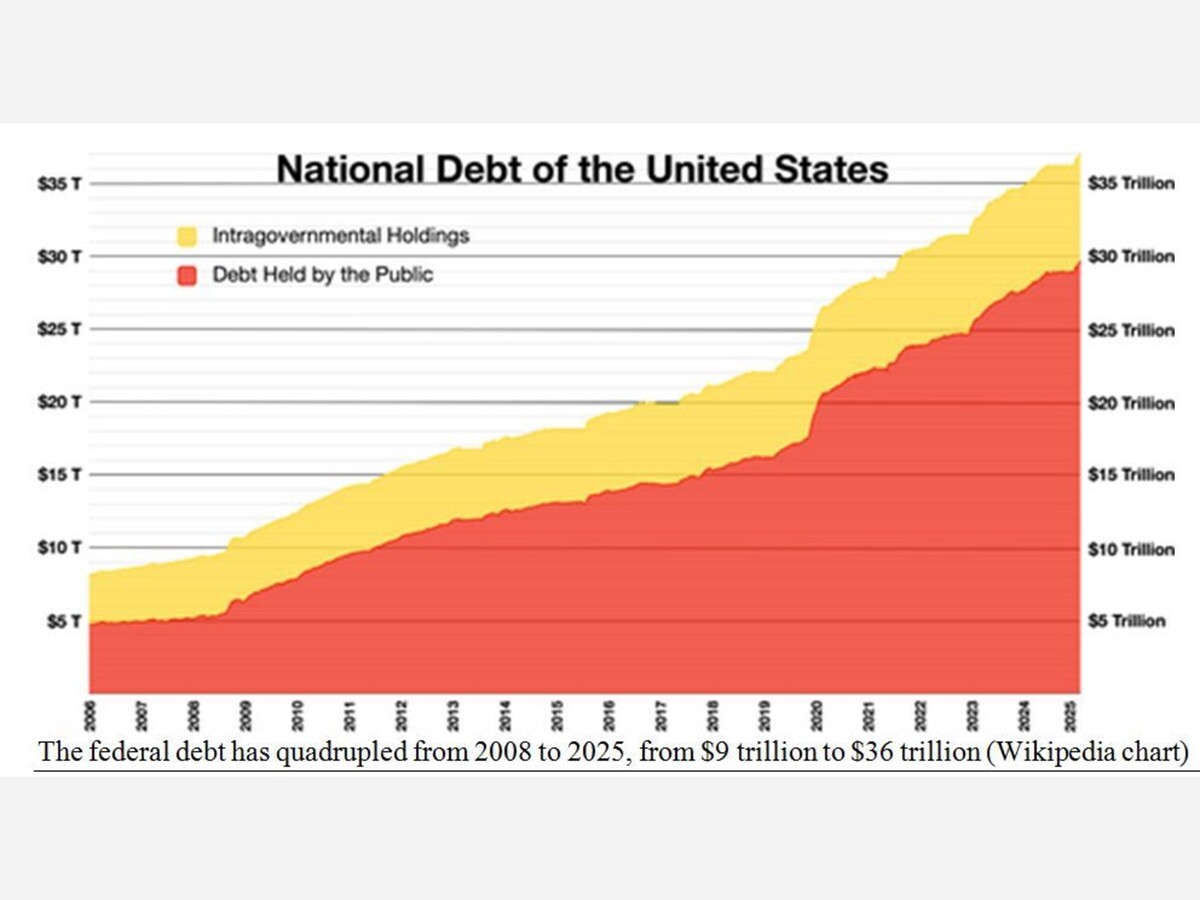
Debt held by the public AND foreign governments. navellier.com



3/2/2026 4:05 PM - this story has been updated to title the graph "Debt held by the public AND foreign governments (estimated to be 25-30%).
WASHINGTON D.C. — Rep. Jodey Arrington, the top Republican on the House Budget Committee, recently described the $38 trillion national debt as “the United States’ next great war,” pointing to nearly $1 trillion in annual interest payments as evidence of a looming fiscal crisis.
But critics argue the roots of today’s debt stretch back more than four decades to the tax-cutting policies first enacted in 1981 under President Ronald Reagan. They contend that successive Republican administrations — including those of George H.W. Bush, George W. Bush, and Donald Trump — pursued supply-side tax reductions that disproportionately benefited wealthy individuals and corporations while significantly reducing federal revenue.
According to this view, those tax cuts drained an estimated $38 trillion from the Treasury over 45 years, contributing heavily to rising deficits. The critics also argue that wage stagnation and weakened labor unions further shifted wealth upward, compounding inequality.
Supporters of supply-side economics have long maintained that lower taxes spur growth and investment. However, opponents say the promised revenue gains never materialized at levels sufficient to offset the cuts, leaving the federal government to borrow heavily to finance spending.
— Thirty-eight trillion dollars is roughly what it would cost to fund a Medicare-for-All-style universal health care system for a decade. In other words, we could have guaranteed health care as a right in America for ten years — every doctor’s visit, every prescription medication, every surgery and ER visit — and still had money left over. And because it would eliminate the need for Medicare and Medicaid, we could run it for a lot longer than just a decade.
— It’s more than twenty times the entire federal student loan debt that our young people are groaning under. We could have made college free and wiped out every penny of student debt in this country over and over again, freeing tens of millions of Americans to buy homes, start businesses, and raise families instead of mailing checks to banks for decades.
— It’s enough money to build tens of millions of affordable homes. Even at $300,000 per unit — a generous estimate — $38 trillion could pay for well over one hundred million homes. That wouldn’t just reduce housing costs; it would fundamentally reset the housing market and break the back of the affordability crisis that’s crushing the middle class.
— It’s enough to make universal pre-K permanent for generations. And, at the same time, it could have made community college tuition-free nationwide, rebuilt every crumbling bridge, modernized the entire electric grid, gotten us off fossil fuels while it hardened our infrastructure against climate disasters, and still left trillions in the bank for healthcare and education.
Critics also point to what they describe as a long-running political strategy: cutting taxes during Republican administrations and raising concerns about deficits during Democratic presidencies. They argue this approach contributed to structural deficits while framing social spending as the primary fiscal threat.
Republicans, meanwhile, have emphasized the need to curb federal spending to rein in debt growth, arguing that entitlement reform and fiscal restraint are necessary to prevent long-term economic harm.
As the national debt continues to climb and interest payments consume a growing share of the federal budget, the debate is intensifying over whether the solution lies in reducing spending, raising taxes on high earners and corporations, or some combination of both.
What remains clear is that the nation’s debt — once under $1 trillion in 1981 — has become a defining issue in Washington, with sharply different interpretations of how it grew and how to address it.

Way back when I was in school an instructor wanted students to understand our national debt was of no great concern because the debt was held by the public--like "we owe it to ourselves ". The chart accompanying this article is likewise labeled "Debt Held By the Public ", but in truth 25 or 30 percent of our debt is now actually held by foreign governments, foreign companies and foreign individuals. So it's no longer just owed to ourselves.



Sunny, with a high of 57 and low of 39 degrees. Patchy rain nearby during the morning, clear during the afternoon and evening,



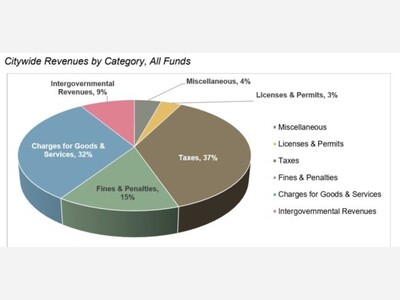
This is really well done and should be read by everyone who will vote on the property tax levy lid increase in our upcoming election. I hope every LFP council member has already read it and understands it.
I'm impressed with the analysis but I didn't see any attribution so am curious to know whether this was written by a human or generated by AI.
Both.