Image
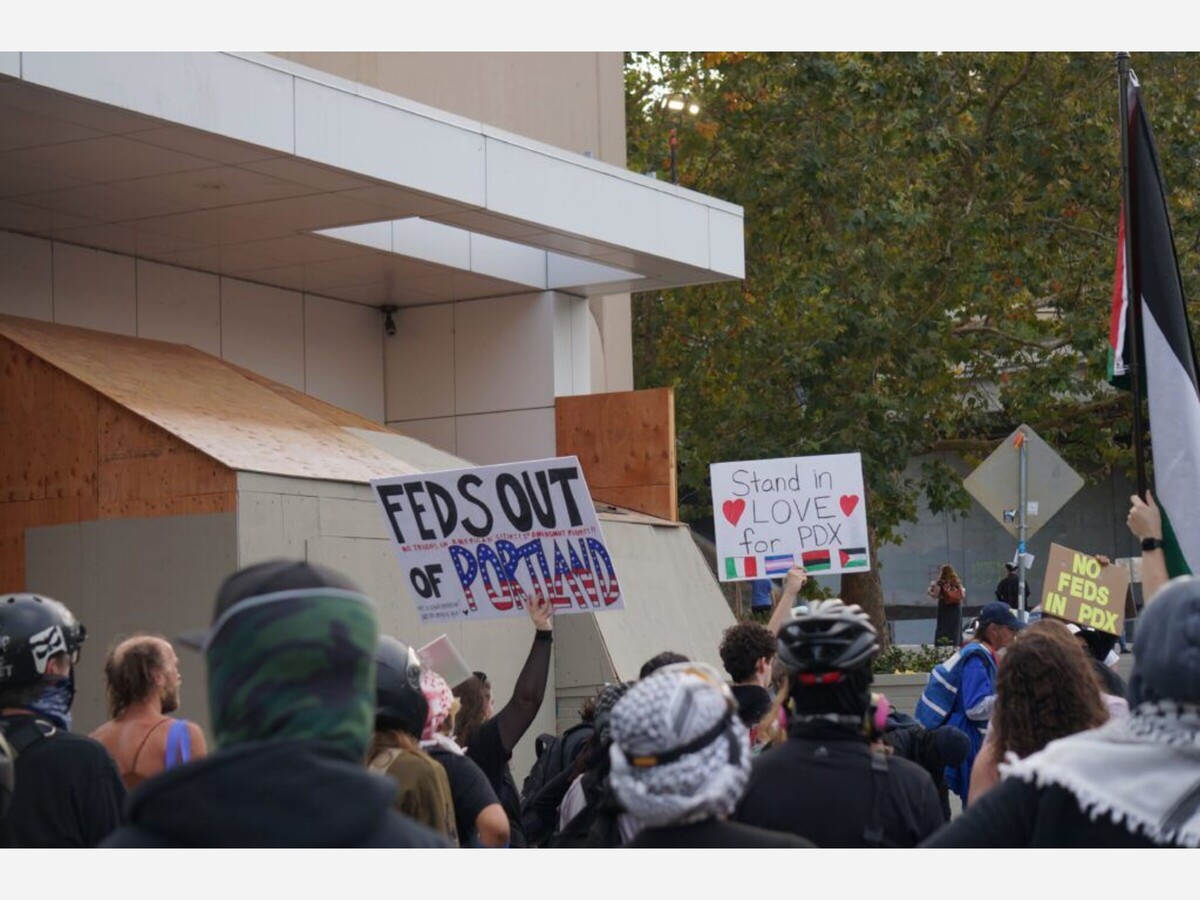
About 200 people showed up to protest outside the Immigration and Customs Enforcement building in Portland on Sunday, Sept. 28. (Photo by Alex Baumhardt/Oregon Capital Chronicle)



Summary:
A federal judge is weighing whether to temporarily block President Donald Trump from federalizing and deploying 200 Oregon National Guard troops to Portland, following a lawsuit by the state of Oregon and the city of Portland.
U.S. District Judge Karin Immergut, a Trump appointee, heard arguments Friday and is expected to rule by Saturday on the state’s request for a temporary restraining order. The case was reassigned to her after Judge Michael Simon recused himself due to his wife, Rep. Suzanne Bonamici, having publicly criticized Trump’s plan.
Oregon officials argue the deployment violates the 10th Amendment and the Posse Comitatus Act, calling it an unprecedented infringement on state sovereignty that could provoke unrest and financial harm. They say the protests at Portland’s ICE facility—used as justification for the federal move—have been mostly peaceful and don’t meet the legal standard of an “active rebellion.”
Federal attorneys countered that troops are needed to protect overworked ICE and Homeland Security officers from “vicious” protesters, citing Trump’s authority under Title 10 of the U.S. Code. However, Immergut questioned the administration’s reliance on Trump’s TruthSocial post announcing the deployment, asking if a social media post could legitimately serve as a presidential order.
Gov. Tina Kotek and Attorney General Dan Rayfield urged Oregonians to remain calm as they await Immergut’s decision, which could immediately halt the planned 60-day deployment.
by Alex Baumhardt, Washington State Standard
October 4, 2025
A federal judge is considering whether to temporarily block President Donald Trump from federalizing and deploying Oregon National Guard troops to Portland following a challenge from the state and the city of Portland.
Judge Karin Immergut of the U.S. District Court in Portland said she would make a decision either Friday or Saturday on whether to grant the city and the Oregon Department of Justice a temporary restraining order, following a two-hour court hearing Friday morning. Immergut, a Trump appointee, took over the case late Thursday after initial Judge Michael Simon agreed to recuse himself because his wife, Democratic U.S. Rep. Suzanne Bonamici, has criticized Trump’s decision.
If granted, the restraining order would immediately halt plans Trump and Secretary of Defense Pete Hegseth announced last weekend to deploy 200 Oregon National Guard troops to Portland for 60 days.
Immergut hadn’t issued a ruling by 5:30 p.m. Friday. In statements, Attorney General Dan Rayfield and Gov. Tina Kotek, both Democrats, urged Oregonians to stay patient.
“I am proud of the work that we, in partnership with Attorney General Dan Rayfield, have argued in the case against the Trump administration’s unlawful deployment of the Oregon National Guard,” Kotek said. “Now, we wait as the judge deliberates. I ask that Oregonians who want to speak out about the recent actions do so peacefully and remain calm.”
Guard members are currently training at Camp Rilea in Warrenton, Oregon’s Democratic U.S. Sen. Jeff Merkley said at a Wednesday news conference.
In his argument for the restraining order, senior assistant Oregon attorney general Scott Kennedy called the attempted federal deployment “one of most dramatic infringements on state sovereignty in Oregon’s history.”
Brian Marshall, also a senior assistant attorney general at the state justice department, and Caroline Turco, senior deputy city attorney for the city of Portland, joined Kennedy.
Arguing against the restraining order for the federal government was attorney Eric Hamilton, who called protestors outside the ICE processing facility south of downtown Portland “vicious and cruel” and said federal police, ICE agents and Department of Homeland Security agents were overworked and needed Guard reinforcement.
Trump has claimed in posts on his social media site TruthSocial that the facility is under attack by anti-fascists and domestic terrorists and used the site to announce he’d attempt to deploy troops to Portland.
The facility has drawn weekly protests of just a couple dozen people in recent months, and they have remained mostly peaceful. The local U.S. attorney has brought charges against 26 people since early June for crimes at the protest site, including arson and resisting arrest. Protests last weekend grew to a couple hundred following Trump’s call for federal reinforcement. The protests have stayed mostly peaceful, with Portland Police arresting several men throughout the week for fighting, including a right-wing influencer, according to reporting in The Oregonian.
At the hearing, lawyers for Oregon and Portland argued that the federal deployment would violate the 10th amendment of the Constitution, which guarantees police power within the states resides with the states, and that sending troops to Portland would cause irreparable harm, including financial harm, by inciting greater protest than would exist without the federal troops.
Hamilton and the U.S. Justice Department lawyers argued that under Title 10 of the U.S. Code, federal troops can be deployed to states to aid in the event of an “active rebellion.” Kennedy for Oregon argued none of the protests at the ICE facility fit that definition.
He said federal leaders “have taken the broadest definition of ‘rebellion,’ essentially defining it as ‘opposing authority.’” That broad definition, Kennedy said, would include behavior protected by the First Amendment that guarantees the right to free speech and assembly, including protests.
Lawyers for the federal government also justified their authority to send troops to Oregon by relying heavily on a June 7 memo from Trump allowing Hegseth to federalize guard troops in California to be sent to L.A. at the height of protests there, “to temporarily protect ICE and other United States government personnel who are performing federal functions.”
Kennedy said that a months-old memo that’s not about events in Portland shouldn’t be used to justify federal intervention in any U.S. location at any time the president decides.
“Why federalize the Oregon Guard on September 28? The answer is still unclear,” he said. “The timing of the defendant’s actions here was wholly arbitrary.”
Hamilton, the federal attorney, argued that federal police at the ICE facility are overwhelmed with protestors and Portland Police are not able to provide adequate help.
Turco, the city’s attorney, provided transcripts of nightly check-ins between Portland Police officials and officials at the ICE building describing many nights where there was “nothing happening” and federal police told the local police they weren’t needed. Most calls from the ICE facility for local backup in recent months were in events of medical emergencies among detainees kept at the facility, Turco said.
Even Hamilton said “there is no emergency here,” when describing the situation at the Portland ICE facility.
The parties also disagreed about the scale of the request, with Hamilton saying 200 Oregon Guard troops are about 3% of the state’s total. Lawyers for Oregon argued that the 200 members being called up are emergency responders and make up 60% of the Oregon Guard’s emergency response force. Because of the federal government shutdown, troops would not be paid until after the government reopened, which Oregon’s attorneys said would cause further financial harm to the troops themselves.
Kennedy said Trump’s declaration that troops were needed in Oregon was made based largely on a fictional narrative. He took issue with the U.S. Department of Justice relying on Trump’s social media post Saturday calling for troops in Portland as a principle document expressing a rationale for the deployment, calling it “the president’s informal commentary to the public.”
Immergut seemed to agree with Kennedy that the social media post did not demonstrate that careful consideration of facts went into the declaration that troops were needed in Portland.
“Really? A social media post is going to count as a presidential determination that you can send the National Guard to cities? That’s really what I should be relying on?” she said.
Rayfield requested the restraining order motion on behalf of the state and the city of Portland as part of their broader lawsuit filed against Trump, Hegseth, U.S. Secretary of Homeland Security Kristi Noem, the U.S. Department of Defense and the U.S. Department of Homeland Security.
That suit alleges the federal leaders and their agencies are not only violating the 10th Amendment by sending troops into Portland, but also the Posse Comitatus Act, which generally forbids military members from conducting domestic law enforcement. The state and Portland also allege the city is being singled out for political retaliation.
This story was originally produced by Oregon Capital Chronicle, which is part of States Newsroom, a nonprofit news network which includes Washington State Standard, and is supported by grants and a coalition of donors as a 501c(3) public charity.
Washington State Standard is part of States Newsroom, a nonprofit news network supported by grants and a coalition of donors as a 501c(3) public charity. Washington State Standard maintains editorial independence. Contact Editor Bill Lucia for questions: info@washingtonstatestandard.com.



Overcast, with a high of 74 and low of 51 degrees. Overcast for the morning, clear for the afternoon and evening, partly cloudy overnight.